Menu
World

Will the UN Security Council endorse a final U.S.-Iran deal by the end of 2026?

Resolution: Updated:

In short

The market treats UN Security Council endorsement by year-end as unlikely. The main reason is timing: the June 2026 memorandum of understanding is a framework, not a finalized deal text, and the Council can only act on a completed agreement. A rapid breakthrough on final terms in the coming weeks, followed by a draft resolution that avoids a Russian or Chinese veto, is what would change this.

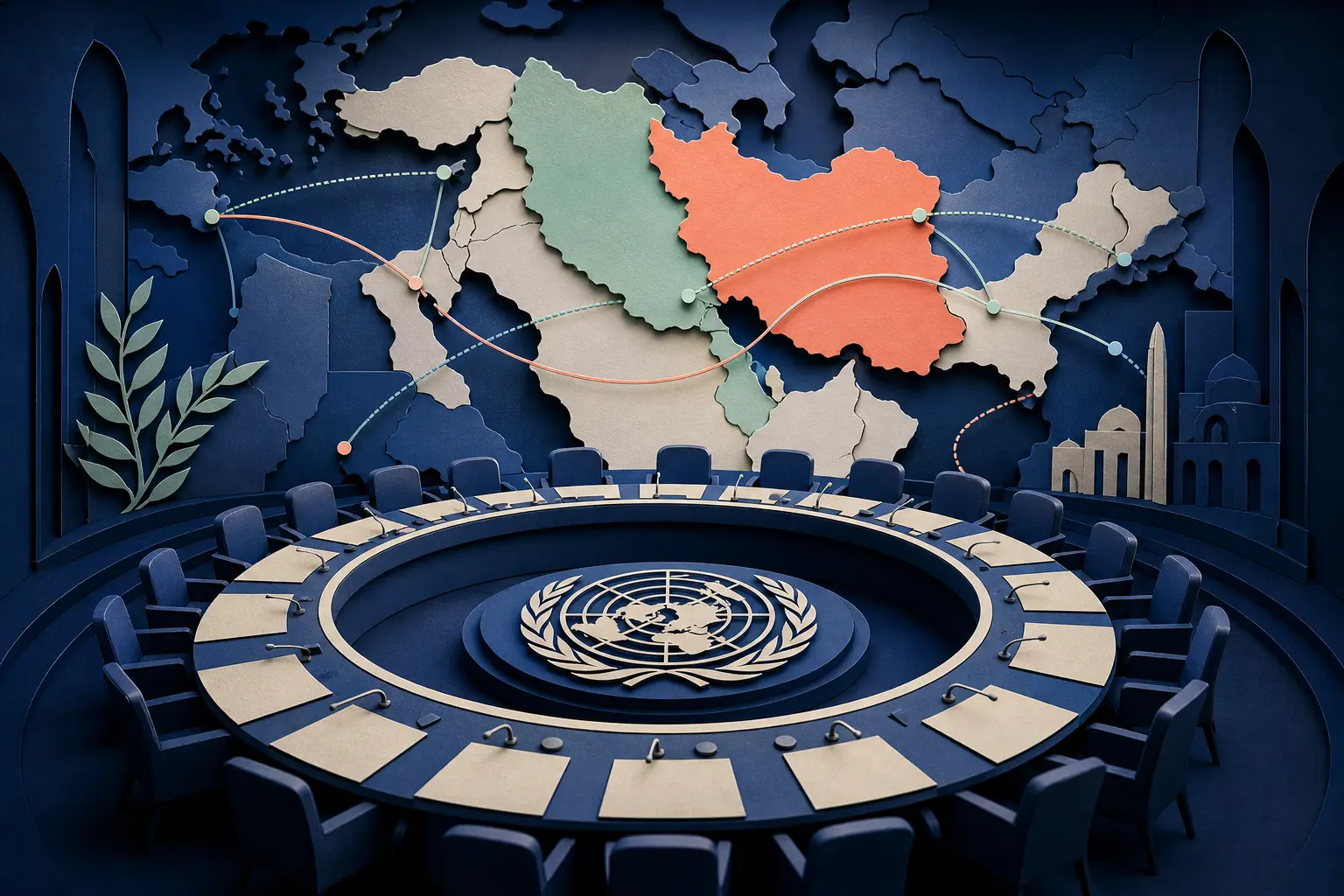
Editorial illustration for: Will the UN Security Council endorse a final U.S.-Iran deal by the end of 2026?

How the contract works

A contract on this question settles at $1 if the UN Security Council formally adopts a resolution endorsing, approving, or giving legal effect to a US-Iran final deal by 31 December 2026, 11:59 PM ET, and settles at nothing if it does not. The price at any moment reflects what buyers and sellers collectively think the chance of that outcome is; a contract trading at 0.30, for example, would imply the market sees roughly a three-in-ten chance of Council action by the deadline, which is not this market's current reading. What counts as the 'final deal' will be judged from the resolution text itself, official US or Iranian statements, or a consensus of credible reporting if the text is ambiguous. A position in the contract can generally be sold before the settlement date at whatever price the market is offering at that time.
What the market thinks happens
$100
Yes5%

The event happens

Costs now
$0.05
If you put in $100
$2,000
No95%

The event does not happen

Costs now
$0.95
If you put in $100
$105

Probability

History starts collecting once the event is tracked

How the price has moved

The only available reading is the current consensus of 9%, concentrated entirely on one venue with $361,140 in total volume; no multi-day or multi-week trend data is available to describe a move up or down. What that single reading communicates is that market participants, on the information available in mid-November 2026, see Security Council endorsement by year-end as a distinct minority outcome rather than a near-certainty or a coin flip.

Analysis

Context

On 14 June 2026, the United States and Iran signed a memorandum of understanding described by both governments as the basis for a 'final deal.' A memorandum is a statement of intent and agreed principles; it is not itself an enforceable treaty and does not bind the UN Security Council to anything. For the Council to act, negotiators first have to convert that framework into finalized legal text covering issues such as enrichment limits, sanctions relief, and verification, and then persuade all five permanent members not to block a resolution. The last time a comparable question arose was 2015, when the Joint Comprehensive Plan of Action was finalized in Vienna on 14 July and the Security Council adopted Resolution 2231 endorsing it just six days later, on 20 July. That episode shows the Council can move quickly once a complete text exists, but reaching that point took more than a year of negotiation after the original framework agreement in April 2015.
The consensus figure across venues is 9%, and the entire tracked volume of $361,140 sits on a single venue, Polymarket. That concentration matters: there is no second venue to compare prices against, so there is no spread to read for disagreement between pools of traders, and the total money behind the number is modest for a geopolitical question of this size. A thin, single-venue market like this tends to reflect a small number of active participants rather than a broad consensus view, which is itself informative about how settled or unsettled public expectations are. No multi-day price history is available here beyond the current consensus reading, so the honest statement is that this is effectively a single data point rather than a trend. The low level is consistent with the structural facts of the case. Six months have passed since the June memorandum was signed, and there is no reported finalized deal text as of mid-November 2026. The Security Council does not vote on frameworks or statements of intent; it votes on completed agreements, as it did with Resolution 2231 only after the JCPOA's full text was agreed in Vienna. With roughly seven weeks left before the 31 December 2026 deadline, that same sequence of text finalization, internal clearance in Washington and Tehran, and then Council drafting and voting would have to happen on a compressed timeline. Veto dynamics add another layer. Any one of the five permanent members, including Russia and China, can block a resolution outright. In 2015 neither raised a formal objection once the JCPOA text was settled, but the broader US-Russia and US-China relationship in 2026 is a separate variable from the Iran talks themselves, and friction on unrelated issues can slow or complicate unrelated resolutions. Domestic review processes on both sides, including any congressional review period in the US modeled on the 2015 precedent, also consume calendar time that the market has to price in.

What moves the probability

  1. Pace of final text negotiation

    The Council cannot endorse a deal that has not been finalized. If negotiators convert the June memorandum into complete legal text within weeks rather than months, the chance of Council action this year rises; continued gaps on core terms push it down.

  2. P5 veto risk

    Russia and China can each block a resolution regardless of what the US and Iran agree bilaterally. Unrelated tension with either government in late 2026 would weigh against a smooth vote, even on a finished text.

  3. Compressed calendar

    Only about seven weeks remain between today and the 31 December 2026 deadline. The 2015 precedent took six days from finished text to Council vote, but getting to a finished text took over a year; a similarly fast finish-to-vote turnaround would still require the text itself to be ready well before the deadline.

  4. Domestic ratification steps

    Review processes in Washington and Tehran, including any legislative review period, add time before either government can present a deal as final to the Council. Delays here directly shrink the window for UN action.

  5. Thin, single-venue pricing

    With all tracked volume on one venue, the 9% consensus reflects a narrow pool of market participants rather than a broad cross-venue signal, making the price more sensitive to individual large trades than in deeper markets.

The case for

  • The June 14, 2026 memorandum of understanding shows both governments are formally committed to a framework for a final deal.
  • The 2015 precedent demonstrates that once a complete legal text exists, the Security Council can adopt an endorsing resolution within days, as it did six days after the JCPOA text was finished in July 2015.
  • Diplomatic momentum or external pressure in the final weeks of 2026 could accelerate finalization of the text faster than the current pace suggests.
  • A narrowly scoped endorsement, rather than a comprehensive one, could be easier to draft and pass than a full treaty-style resolution.

The case against

  • No finalized 'final deal' text has been publicly reported as of 11 November 2026, five months after the memorandum was signed.
  • The historical comparison shows that moving from a framework agreement to a finished, Council-ready text took the JCPOA process more than a year, not seven months.
  • Any one of the five permanent members, including Russia or China, can block a resolution for reasons unconnected to the substance of the Iran talks.
  • Domestic review procedures in the US and Iran typically run for weeks, leaving little slack before the 31 December 2026 deadline even if a text is finished soon.

What to watch

The key date is 31 December 2026, 11:59 PM ET, the settlement deadline. Between now and then, watch for any announcement that the US and Iran have finalized legal text building on the June 14 memorandum, any scheduling of a Security Council session on Iran, and public statements from Russia or China signaling support or objection to a resolution. Any domestic legislative review process in Washington or a ratification step in Tehran would also be a signal of how much runway remains before the deadline.

Trade this contract

Venues (1)

Open on PolymarketYes 0.05
  • gas covered
  • no trading fee

More about this event

Venues (1)

Resolution rules

Determined by
Consensus of credible reporting on UN Security Council actions
Resolution date

This resolves Yes if the United Nations Security Council formally adopts a resolution endorsing, approving, implementing, giving legal effect to, or incorporating a 'final deal' between the US and Iran, as contemplated by the June 14, 2026 memorandum of understanding, by 31 December 2026, 11:59 PM ET. What counts as the 'final deal' is determined from the resolution's own text, official US or Iranian government communications, or, failing those, a consensus of credible reporting. If no such resolution is adopted by the deadline, this resolves No.

Calculation methodology โ†’

Local context

A Security Council endorsement of a final US-Iran deal would be read as a turning point for sanctions relief, and sanctions relief on Iranian oil exports has a direct channel into global oil prices, which feed into fuel costs across the US, UK, Canada, Australia and India. It also sits squarely in ongoing US foreign policy coverage that this audience already follows, alongside Congress's role in reviewing any nuclear-related agreement, a process with a direct precedent in the 2015 Iran Nuclear Agreement Review Act.

Common questions

What exactly needs to happen for this to resolve Yes?
The UN Security Council has to formally adopt a resolution that endorses, approves, implements, or gives legal effect to a 'final deal' between the US and Iran, as contemplated by the June 14, 2026 memorandum, by 31 December 2026, 11:59 PM ET. A memorandum alone, or a deal that is agreed but never brought to the Council, would not be enough.
What does the current price actually mean?
The price is the market's running estimate of the probability of Council endorsement by the deadline, not a prediction from any official source. A price of 9% means market participants collectively see this as a minority outcome, roughly consistent with it happening about once in eleven similar situations, not as settled either way.
What happens if the deal is announced as final but the Council doesn't vote before the deadline?
The contract settles on Council action, not on the existence of a deal. If a final deal is announced but no resolution is adopted by 31 December 2026, 11:59 PM ET, this resolves No regardless of the deal's status outside the UN.
What if it's unclear whether a resolution counts as an endorsement of the 'final deal'?
The rules specify that ambiguous cases are judged against the resolution's own text, official US or Iranian communications, and a consensus of credible reporting. This mirrors how the 2015 JCPOA case was judged: Resolution 2231 explicitly named and endorsed the agreement, leaving little room for dispute.
Why did the 2015 Iran nuclear deal take so long to reach the Security Council?
The April 2015 framework agreement needed more than a year of further technical and legal negotiation before a complete text was ready in Vienna on 14 July 2015. The Council then acted quickly, adopting Resolution 2231 just six days later, which shows the finishing step can be fast once the text itself is done.
Does Russia or China have to actively support the resolution, or just not block it?
Any of the five permanent members can block a resolution with a single veto, so each one effectively just needs to decline to vote No. In 2015 neither Russia nor China vetoed Resolution 2231, but their stance in 2026 depends on the broader state of relations with Washington at the time of any vote.

Related events