Menu
World

Will Ukraine recapture any territory in Crimea by 31 December 2026?

Resolution: Updated:

In short

The market treats a Ukrainian foothold inside Crimea by the end of 2026 as unlikely. Ukraine has struck targets across the peninsula for years but has not held ground there, and the front lines in the south have moved little since 2023. A shift would most likely come from either a sudden collapse of Russian defenses on the Perekop isthmus or a negotiated settlement that hands over land, neither of which is currently underway.

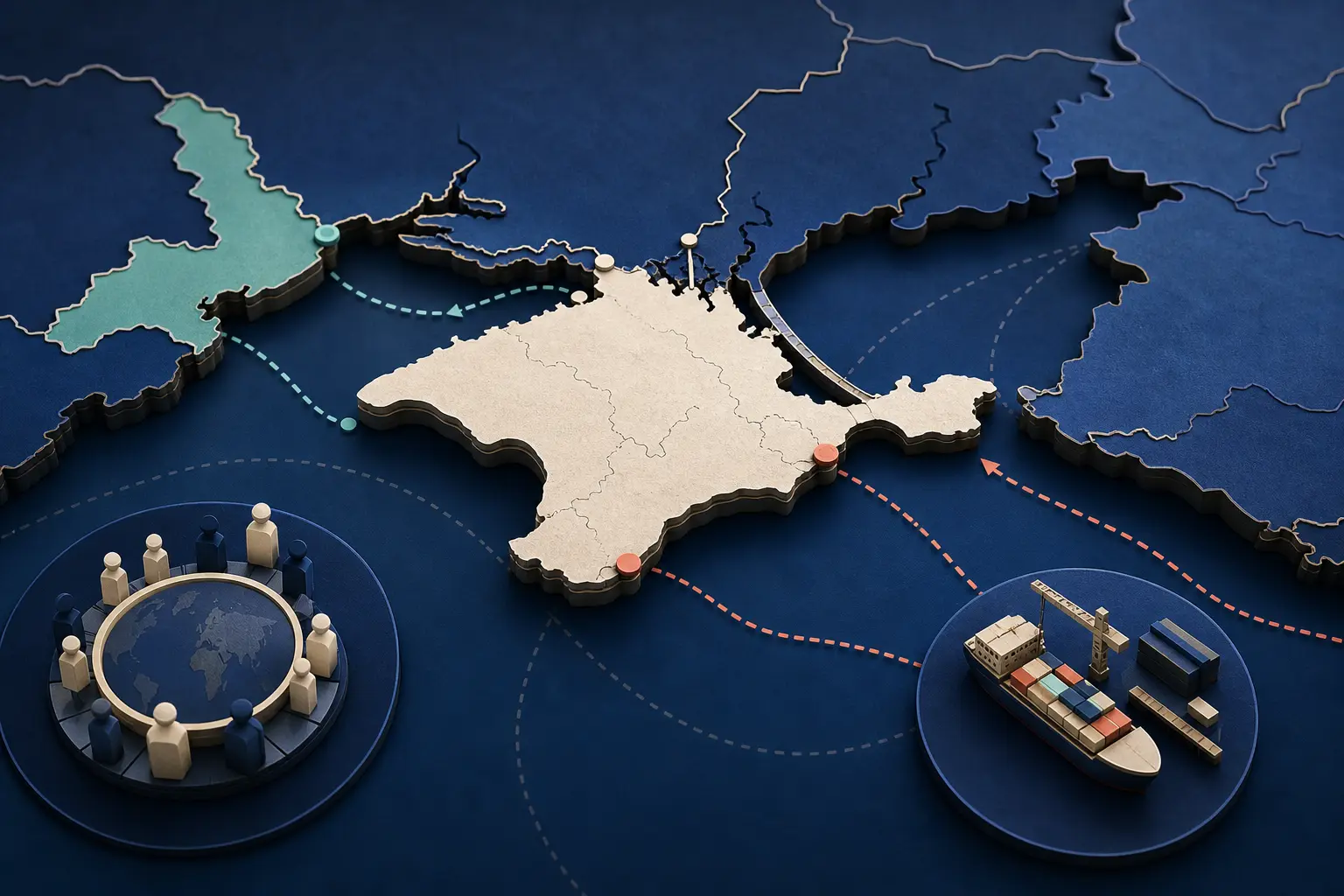
Editorial illustration for: Will Ukraine recapture any territory in Crimea by 31 December 2026?

How the contract works

This contract is a simple yes-or-no claim on a single fact: does the ISW map show any part of Crimea under Ukrainian control by 31 December 2026, and does that control hold through the following daily update. If it does, the contract settles at $1; if not, it settles at nothing. The price at any moment reflects what buyers and sellers currently think the chance of that is — a contract priced at $0.30, for example, would imply traders see it happening roughly three times in ten, not that it is guaranteed either way. Anyone holding a position can typically sell it before 31 December 2026 at whatever price the market has moved to by then, rather than waiting for settlement.
What the market thinks happens
$100
Yes9%

The event happens

Costs now
$0.09
If you put in $100
$1,111
No91%

The event does not happen

Costs now
$0.91
If you put in $100
$110

Probability

History starts collecting once the event is tracked

How the price has moved

The consensus across venues currently sits at 9%, all of it reflected in Polymarket's $2,486,207 in trading volume, the only venue listing this contract. A single-digit price this late into a war where Crimea has been a fixed Russian stronghold since 2014 indicates a market that views the resolution criteria — actual, persisting ground control — as a materially higher bar than the strikes and naval setbacks Ukraine has already inflicted on the peninsula. No day-by-day or week-by-week move data is available beyond this consensus figure, so the current level should be read as the market's settled view rather than the result of a recent shift.

Analysis

Context

Russia annexed Crimea in 2014 and has since built it into a heavily fortified logistics and naval hub for its war in Ukraine. Since the full-scale invasion began in February 2022, Ukraine has repeatedly struck the peninsula with missiles and long-range drones, damaged the Kerch Strait bridge twice, and pushed much of Russia's Black Sea Fleet out of Sevastopol. None of that has translated into Ukrainian forces occupying and holding Crimean soil. The land route into Crimea runs through the narrow Perekop isthmus and the Chonhar causeways, both of which Russia has fortified since 2022 with layered minefields, trenches and defensive lines similar to those that stalled Ukraine's 2023 counteroffensive in Zaporizhzhia. Ukraine's manpower and ammunition constraints, repeatedly flagged by Kyiv and its Western backers through 2024 and 2025, have limited its ability to mount a large ground offensive rather than defend existing lines. The question is settled by the Institute for the Study of War's daily control-of-terrain map, a widely cited open-source tracker of the front line that both governments and independent analysts reference. A Yes requires the map to shade any part of Crimea as Ukrainian-controlled and for that shading to persist through the next update, whether from a battlefield gain or a negotiated transfer of territory.
Across venues tracking this question, the consensus sits at 9%, with all recorded volume — $2,486,207 — concentrated on Polymarket. A single-digit price this deep into the war reflects a market that has watched three and a half years of fighting produce Ukrainian strikes on Crimea but no sustained ground presence there, and that has priced the gap between striking a target and holding territory accordingly. The core constraint is geographic and military, not political will. Crimea is connected to the mainland by a narrow isthmus that Russia has spent years turning into one of the most fortified stretches of front in the war, echoing the defensive depth that blunted Ukraine's 2023 counteroffensive further north in Zaporizhzhia. Amphibious or airborne routes into Crimea face Russia's Black Sea air defenses and naval presence, degraded but not eliminated despite Ukrainian strikes on Sevastopol and the Kerch bridge. A second route to Yes does not run through combat at all: the settlement rules count territory transferred under a negotiated agreement. Any ceasefire framework discussed since 2022 has generally assumed a freeze along existing lines or Russian retention of occupied territory, not a Ukrainian gain in Crimea, so this path currently looks no more probable than a battlefield breakthrough. The volume figure — under $2.5 million on one venue — signals a market that is thin relative to headline geopolitical contracts, but not one lacking conviction; a single-digit price with real money behind it indicates traders see this largely as a settled question barring a major shock, such as a sudden Russian military collapse or an unexpected land-swap deal.

What moves the probability

  1. Perekop isthmus defenses

    Russia has spent years fortifying the narrow land approaches into Crimea with layered minefields and trenches, the same style of defense that stopped Ukraine's 2023 counteroffensive elsewhere. This is the single largest factor keeping the probability low, since any ground route into Crimea has to pass through it.

  2. Ukraine's manpower and ammunition supply

    Ukraine's ability to mount offensive rather than defensive operations depends on troop numbers and Western-supplied ammunition, both of which have been strained since 2024. A shortage here pushes the probability down by limiting any large-scale push toward Crimea.

  3. Negotiated settlement terms

    The rules count territory gained through a peace deal as a Yes. If ceasefire talks produce a framework where Ukraine retains or regains any strip of Crimean land, that would resolve the question without a shot fired, though current negotiating positions do not point that way.

  4. Long-range strikes versus ground control

    Ukrainian missile and drone strikes on Sevastopol, the Kerch bridge and Russian naval assets have weakened Russia's position in Crimea but do not by themselves establish control under the ISW mapping standard, which requires shaded ground control, not degraded enemy capability.

The case for

  • A collapse in Russian defensive lines on the Perekop isthmus or Chonhar causeways during 2026 could open a route for Ukrainian forces to establish and hold a foothold inside Crimea.
  • A negotiated settlement reached before 31 December 2026 that transfers any Crimean territory to Ukraine would satisfy the resolution criteria without any ground offensive.
  • Continued Ukrainian strikes on Russian logistics, air defenses and naval assets in Crimea could, over time, degrade Russia's ability to defend the peninsula enough to make a limited incursion feasible.

The case against

  • The front line in southern Ukraine has shown limited movement since 2023, and Russia's defensive works around Crimea are among the most developed in the war.
  • Ukraine's publicly acknowledged manpower and ammunition constraints make a large offensive operation toward Crimea unlikely in the time remaining before the resolution date.
  • Ceasefire discussions to date have generally centered on freezing current lines or acknowledging Russian control of occupied territory, not returning Crimean land to Ukraine.

What to watch

Key dates ahead include any Ukrainian offensive planning tied to the 2026 spring and summer fighting seasons, when past counteroffensives have historically launched, and any formal ceasefire or peace framework announced by Kyiv, Moscow or Western mediators before 31 December 2026. ISW's daily control-of-terrain updates are the direct trigger for resolution, so any sustained change in shading over Crimea would be the first visible signal. Continued large-scale Ukrainian strikes on Sevastopol or the Kerch bridge are worth watching as indicators of capability, though they do not themselves satisfy the resolution criteria.

Trade this contract

Venues (1)

Open on PolymarketYes 0.09
  • gas covered
  • no trading fee

More about this event

Venues (1)

Resolution rules

Determined by
ISW (Institute for the Study of War) daily control-of-terrain map
Resolution date

Resolution depends on the Institute for the Study of War's daily control-of-terrain map for Ukraine. A Yes outcome requires the map to shade some part of Crimea as under Ukrainian control by 31 December 2026, 11:59 PM ET, whether from reported gains, claimed counteroffensives, or a negotiated territorial transfer, and that shading must persist through the next finalized ISW update. The black border line marking Crimea's boundary on the map does not by itself count as control. Once a qualifying Yes is recorded, any later loss of that territory does not reverse the resolution. If none of these conditions are met by the deadline, the contract resolves No.

Calculation methodology

Local context

For US, UK, Canadian and Australian audiences, this question sits inside the broader debate over continued military and financial aid to Ukraine, a recurring flashpoint in the US Congress and in NATO summit communiqués since 2022. The size and pace of Western weapons deliveries — long-range missiles, air defense systems, ammunition — directly shape whether any Ukrainian push toward Crimea becomes militarily plausible before the end of 2026. A negotiated settlement affecting Crimea would also be shaped heavily by US and European diplomatic involvement, making this a live proxy for how those governments' Ukraine policy plays out on the ground.

Common questions

What exactly settles this contract, and when
The Institute for the Study of War's daily control-of-terrain map is the sole determinant. If it shows any part of Crimea shaded as Ukrainian-controlled by 31 December 2026, 11:59 PM ET, and that control holds through the next finalized update, the contract resolves Yes.
Does a missile strike or drone attack on Crimea count as Yes
No. The rules require ISW to show actual ground control, not damage from a strike. Ukraine has hit targets across Crimea repeatedly since 2022 without that being reflected as territorial control on the map.
What does a low price like this actually mean
A low market-implied probability means traders currently see this outcome as unlikely, based on the balance of military and political conditions, not that it is impossible. Prices adjust as new information, such as battlefield movement or ceasefire talks, changes that assessment.
What happens if the ISW map is ambiguous or a ceasefire is still being negotiated on the deadline
The rules rely specifically on ISW's finalized daily map as of the resolution date. If a negotiated settlement transfers Crimean territory to Ukraine, that also counts as Yes regardless of the battlefield situation, but absent either clear ISW-recorded control or a finalized transfer, the contract resolves No.
Why is Crimea harder for Ukraine to retake than mainland territory it has recovered before
Crimea is connected to the rest of Ukraine only by a narrow isthmus and causeways that Russia has fortified extensively since 2014 and especially since 2022, unlike open front sections elsewhere. It is also further from Ukrainian supply lines and covered by concentrated Russian air defense and naval assets based at Sevastopol.
Can a position in this contract be closed before the resolution date
Yes, positions can generally be sold on the venue where they were opened at the prevailing market price at any time before 31 December 2026, rather than being held to settlement.

Related events

9%/ 92%
Yes / No