Menu
World

Will Russia and Ukraine hold peace talks by 31 October 2026?

Resolution: Updated:

In short

The market treats a meeting by 31 October 2026 as more likely to fail than to happen, but not a remote possibility. The biggest reason is time: fewer than three weeks remain, and no direct session between Russian and Ukrainian negotiators has been confirmed since the Istanbul round of March 2022, with intermediary channels so far limited to prisoner exchanges rather than broader peace terms. A credible, announced sit-down covering ceasefire, territory or security guarantees โ€” even brief โ€” would flip this quickly toward Yes.

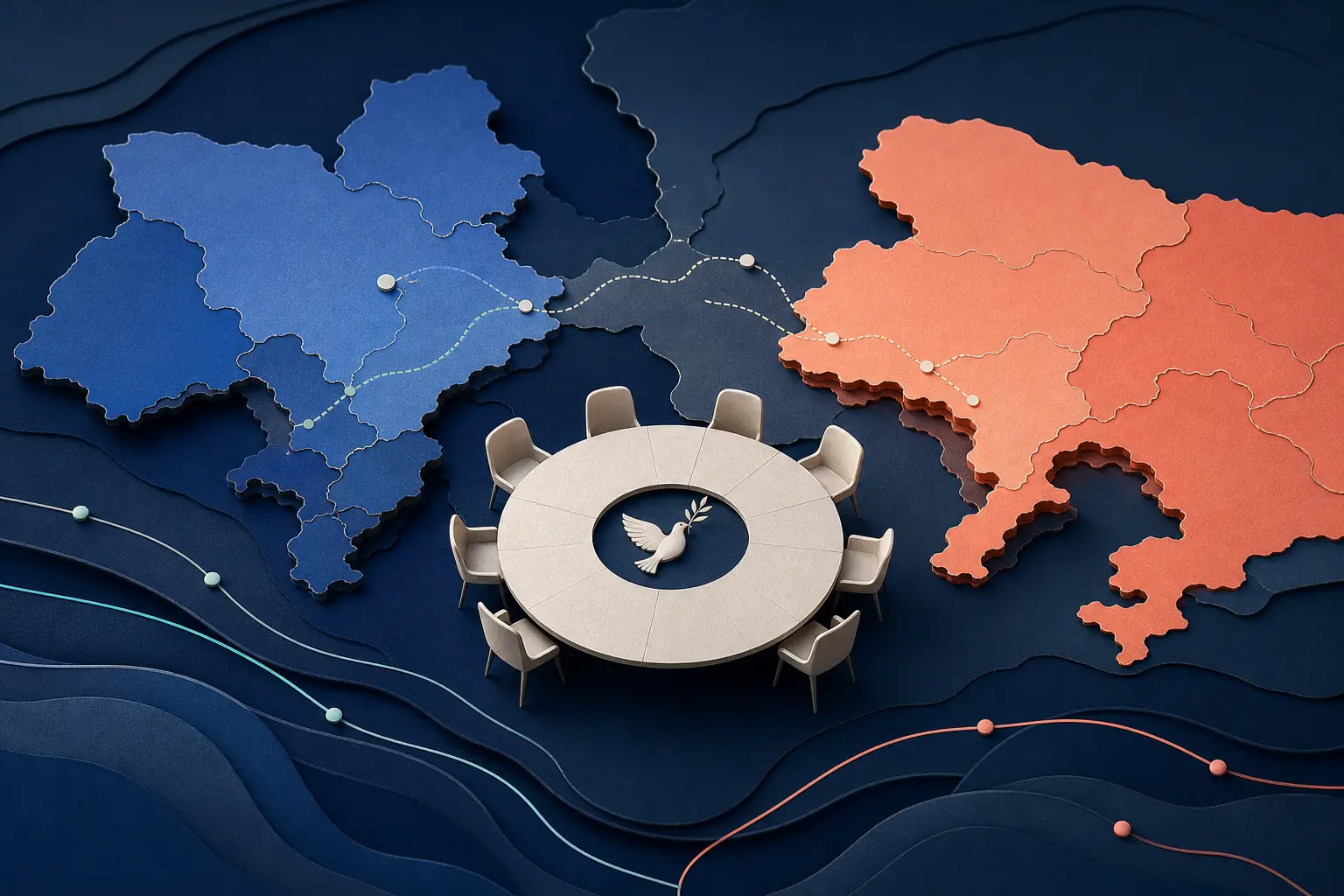
Editorial illustration for: Will Russia and Ukraine hold peace talks by 31 October 2026?

How the contract works

This market works like a binary claim on a single calendar event: the contract settles at $1 if a qualifying meeting takes place by the deadline, and at nothing if it does not. The price at any moment reflects what traders are willing to pay for that $1 claim, which is the same as saying it reflects their collective estimate of the chance the meeting happens โ€” a contract priced at 0.30, for example, would imply traders see roughly a three-in-ten chance, not that the event is three-tenths likely in some other sense. Settlement is tied to 31 October 2026, 11:59 PM ET, and judged against the rules set out by the market: an in-person meeting between authorized representatives, directly or through designated mediators, that addresses ceasefire, peace terms, territory or security guarantees. A position in this contract can typically be sold before the deadline at whatever price the market has moved to by then, rather than held to settlement.
What the market thinks happens
$100
Yes24%

The event happens

Costs now
$0.24
If you put in $100
$417
No76%

The event does not happen

Costs now
$0.76
If you put in $100
$132

Probability

History starts collecting once the event is tracked

How the price has moved

The consensus figure stands at 25%, built from a single venue, Polymarket, with $288,601 traded. Because only one venue carries a price, there is no spread between markets to indicate disagreement among different trader pools โ€” the figure reflects one set of positions rather than a cross-checked average. No detailed day-over-day or week-over-week trajectory is available in the source data, so the fair reading is that the market has arrived at a quarter-probability level without a single identifiable public trigger driving recent movement, which is itself informative: it suggests steady skepticism rather than a market reacting to a specific recent diplomatic development.

Analysis

Context

The question asks whether Russia and Ukraine will hold a qualifying diplomatic meeting before 31 October 2026, addressing a ceasefire, a peace agreement, or other substantive de-escalation. The war has run since February 2022, with the only confirmed direct negotiating session between the two governments taking place in Istanbul in March 2022, which collapsed without an agreement. Since then, contact between Moscow and Kyiv has mostly run through third parties โ€” Turkey, Gulf states and others โ€” and has centered on narrower matters like prisoner swaps and grain corridors rather than a full peace framework.
The consensus figure across tracked venues sits at 25%, drawn entirely from Polymarket, the only venue currently trading this question, with $288,601 in volume. Because there is only one venue, there is no cross-market spread to read for disagreement โ€” the number represents one pool of traders rather than an aggregate of competing views, which is worth noting when judging how much weight to put on it. The public record available here does not include a granular day-over-day or week-over-week breakdown, so the honest reading is that the price has settled near a quarter without a documented single trigger for recent movement, rather than that it has been flat by some deliberate signal. The substantive case rests on what has and has not happened diplomatically. The last confirmed direct engagement between Russian and Ukrainian negotiators was the Istanbul round in March 2022, over four years before this market's deadline. Since then, most contact has run through intermediaries and has been confined to discrete humanitarian issues โ€” prisoner exchanges, grain shipments โ€” which under this market's own rules would not qualify unless broader peace terms were also on the table. That history matters because it sets the base rate: in roughly four and a half years of war, a qualifying broad-agenda meeting has happened roughly once, which is the kind of frequency a 25% probability over a three-week window is implicitly weighing against. At the same time, the question does not require a breakthrough โ€” only a meeting that addresses ceasefire, territory or security guarantees, even through mediators, and even if it produces no agreement. That is a lower bar than a peace deal, and it is one reason the price sits well above zero rather than near it. Diplomatic channels involving Turkey, Gulf states and Washington have stayed open intermittently throughout 2025 and 2026, and any of them could, in principle, be upgraded to a qualifying session on short notice. The narrow window to 31 October 2026 is the main constraint: arranging, confirming and holding such a meeting typically takes weeks of advance signaling, and none of that groundwork has been publicly confirmed as already underway.

What moves the probability

  1. Narrow time window

    Fewer than three weeks remain between now and the 31 October 2026 deadline. Meetings of this kind have historically required weeks of prior signaling through intermediaries, so the short runway pushes the probability down relative to a longer-dated version of the same question.

  2. No confirmed direct channel since 2022

    The last documented direct session between Russian and Ukrainian negotiators was Istanbul in March 2022. The absence of a standing direct channel since then is the single largest drag on the probability, because it means any meeting now would require building new diplomatic infrastructure rather than reactivating an existing one.

  3. Existing mediator channels

    Turkey and Gulf states have maintained indirect contact on humanitarian issues like prisoner swaps. If any of these channels were widened to cover ceasefire or territorial terms, it would immediately satisfy the resolution criteria and this is the most plausible near-term path to Yes.

  4. US diplomatic posture

    Washington's involvement in any peace framework or sanctions-relief discussion has been central to prior rounds of engagement. A visible US-brokered session, even a short one, would count under the rules and is the kind of event that could move the price quickly if announced.

  5. Single-venue pricing

    With only Polymarket trading this question and $288,601 in volume, the market has less depth than a multi-venue question would, which means the price can be more sensitive to a handful of large positions rather than broad consensus.

The case for

  • A Turkey- or Gulf-mediated channel currently limited to prisoner exchanges could be widened to cover ceasefire or territorial terms before 31 October 2026.
  • A US-brokered session, consistent with Washington's stated role in prior negotiation efforts, would qualify under the resolution rules even without a signed agreement.
  • The bar is deliberately low: any in-person meeting addressing ceasefire, territory or security guarantees counts, even one that produces no breakthrough.
  • Battlefield stalemate conditions, if they persist into late October 2026, have historically been a precondition that pushes both sides toward at least exploratory contact.

The case against

  • No direct meeting between Russian and Ukrainian negotiators has been confirmed since Istanbul in March 2022, meaning any new session would require building contact from scratch within roughly three weeks.
  • Russia's and Ukraine's stated conditions for talks โ€” territorial recognition on one side, full withdrawal on the other โ€” remain publicly unreconciled, leaving no obvious agenda for a qualifying meeting.
  • Meetings confined to humanitarian matters such as prisoner swaps explicitly do not satisfy the resolution criteria unless broader peace terms are also addressed.
  • A three-week window is short by the standard of how long prior rounds of pre-negotiation signaling have taken to produce an actual sit-down.

What to watch

The clearest signal would be any public announcement of a scheduled meeting between Russian and Ukrainian representatives, or confirmation that an existing mediator channel โ€” Turkey, Gulf states, or Washington โ€” is being expanded beyond humanitarian issues to cover ceasefire or territorial terms. Statements from the US administration regarding a peace framework or sanctions relief, given its central role in prior engagement, would also be worth tracking. With the deadline falling on 31 October 2026, 11:59 PM ET, any credible signal in the final week would need to translate into an actual in-person session, not just an announcement of intent, to satisfy the resolution rules.

Trade this contract

Venues (1)

Open on PolymarketYes 0.24
  • gas covered
  • no trading fee

More about this event

Venues (1)

Probability

  • Russia-Ukraine peace talks by November 30, 2026?41%
  • Russia-Ukraine peace talks by October 31, 2026?24%
  • Russia-Ukraine peace talks by October 15, 2026?2%

Resolution rules

Determined by
Polymarket (polymarket.com)
Resolution date

This market is determined by Polymarket (polymarket.com). It resolves Yes if an in-person diplomatic meeting between authorized representatives of Russia and Ukraine โ€” held directly or through designated mediators โ€” takes place by 31 October 2026, 11:59 PM ET, and addresses a ceasefire, peace agreement, or other substantive de-escalation. Meetings confined to humanitarian issues do not qualify unless broader peace terms are also discussed, and brief greetings or chance encounters are explicitly excluded. If no such meeting occurs by the deadline, it resolves No.

Calculation methodology โ†’

Local context

US and UK policymakers sit at the center of any peace framework for this war, including the sanctions-relief questions that would accompany a negotiated settlement โ€” decisions made in Washington and London would shape the terms on the table long before a meeting is confirmed. For readers in the US, UK, Canada and Australia, the practical channel is indirect: a confirmed meeting would move expectations around Western sanctions policy, defense spending commitments, and energy markets tied to the war's trajectory, even before any agreement is reached.

Common questions

What exactly needs to happen for this to resolve Yes?
An in-person meeting between authorized representatives of Russia and Ukraine, held directly or through designated mediators, that addresses a ceasefire, peace agreement, or other substantive de-escalation, before 31 October 2026, 11:59 PM ET. A meeting limited to humanitarian issues like prisoner swaps does not qualify unless it also covers broader peace terms.
What does the current price actually mean?
The price reflects what traders collectively think the chance of a qualifying meeting is, expressed as a number between 0 and 1. It is not a prediction from any official source, just the level at which buyers and sellers are currently willing to trade the contract.
What happens if a meeting is announced but then postponed past 31 October 2026?
Under the stated rules, the meeting has to actually occur by the deadline for the market to resolve Yes. An announced-but-unheld meeting, or one postponed beyond 31 October 2026, 11:59 PM ET, would resolve the market No regardless of the announcement.
Has a meeting like this happened before in this war?
Yes, once directly โ€” the Istanbul round in March 2022, which did not produce an agreement. Since then, contact between the two sides has mostly run through intermediaries and has focused on narrower humanitarian issues rather than ceasefire or territorial terms.
Why is only one venue listed for this market?
Polymarket is currently the only tracked venue trading this specific question, with $288,601 in volume. That means there is no second price to compare against, so the 25% consensus reflects a single pool of trading activity rather than an average across markets.
Does a meeting on just prisoner exchanges count?
No. The resolution rules explicitly exclude meetings limited to humanitarian issues unless they also address broader peace terms such as ceasefire, territory, or security guarantees.

Related events