Menu
World

Will a NATO member invoke Article 5 before 2027?

Resolution: Updated:

In short

The market treats a formal Article 5 invocation before 2027 as unlikely. Article 5 has been invoked only once in NATO's history, after the 9/11 attacks, and the current war in Ukraine involves a non-member state, which keeps the legal threshold from being met. That would change quickly if a Russian strike killed troops or destroyed territory clearly belonging to a NATO member and Moscow's responsibility were not in doubt.

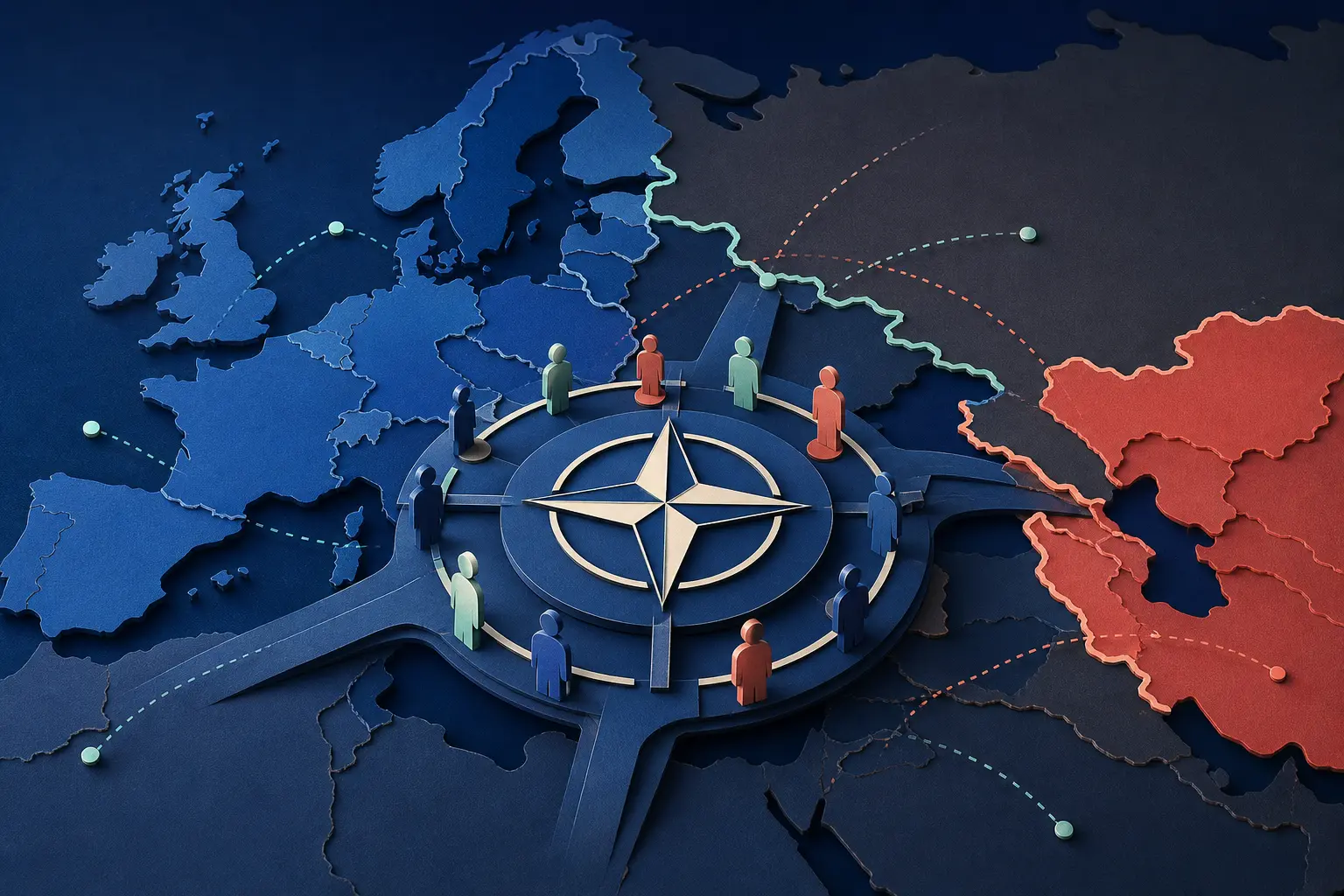
Editorial illustration for: Will a NATO member invoke Article 5 before 2027?

How the contract works

This contract settles at $1 if a NATO member formally invokes Article 5 between 5 November 2025 and 31 December 2026, and at nothing if that does not happen by 31 December 2026 at 11:59 PM ET. The price at any moment reflects what buyers and sellers currently think the chance is; a contract priced at 0.30, for example, would mean the market sees roughly a three-in-ten chance of invocation in that window, not that the event is guaranteed or ruled out. NATO's own statements are the primary source for resolution, with a consensus of credible media reporting used as a backup if NATO's position is unclear. A position in this contract can typically be sold before the settlement date at whatever price the market is offering at that time.
What the market thinks happens
$100
Yes7%

The event happens

Costs now
$0.07
If you put in $100
$1,429
No93%

The event does not happen

Costs now
$0.93
If you put in $100
$108

Probability

History starts collecting once the event is tracked

How the price has moved

The consensus price across the tracked venue sits at 7%, with all $263,724 in recorded volume concentrated on Polymarket, the only venue currently listing this contract. With just one venue reporting, there is no cross-venue spread to compare, and detailed day-to-day or week-to-week price history is not available here. What the level itself communicates is that the market has, so far, treated a formal Article 5 invocation before 2027 as a low-probability tail event tied to the war in Ukraine rather than a near-term expectation, consistent with the fact that the legal threshold requires an attack on a member state's own territory, something that has not occurred.

Analysis

Context

Article 5 of the North Atlantic Treaty commits every NATO member to treat an armed attack on one ally as an attack on all. It is the alliance's founding promise and its most consequential clause, because invoking it can draw the United States, the United Kingdom and 30 other members into direct military action. In NATO's 76-year history it has been invoked exactly once: on 12 September 2001, when the United States asked allies to treat the previous day's attacks as grounds for collective defense. The question sits against the backdrop of the war in Ukraine, now in its fourth year, and a string of incidents along NATO's eastern flank involving Russian drones, aircraft and missiles near or inside member airspace. Ukraine itself is not a NATO member, so Russian strikes there, however large, do not on their own meet the legal bar for Article 5. Any invocation would require an armed attack on the territory, forces or vessels of an actual member state, and a decision by the North Atlantic Council, where all 32 members must agree. This contract resolves Yes if any NATO member formally invokes Article 5 between 5 November 2025 and 31 December 2026. It resolves No if no such invocation occurs in that window, regardless of how tense the situation on NATO's borders becomes.
The market-implied probability sits at 7% across the venue tracked here, which is Polymarket, with $263,724 traded on the question so far. That is a low figure for a geopolitical contract tied to an active war, and it reflects a specific legal reality: the fighting in Ukraine, however intense, has not produced an armed attack on the sovereign territory of a NATO member that Russia has clearly and undeniably carried out. Airspace incidents involving drones and aircraft near NATO's eastern border have prompted consultations under Article 4, which allows members to raise concerns without triggering collective defense, but that is a materially lower bar than Article 5. History is the strongest anchor for a low price. NATO has existed since 1949 and been through the Cold War, the Balkan wars, and now the largest land war in Europe since 1945, and Article 5 has been invoked only once, in the aftermath of 9/11. Even that invocation took a mass-casualty attack on US soil with an identifiable perpetrator to produce alliance-wide consensus. A war fought primarily on non-member territory, however destabilizing, does not by itself clear that bar, and the market's single-digit price reflects the fact that traders see the legal and political threshold as still far from being met. The fact that only one venue currently lists this contract, with a moderate but not enormous volume of $263,724, suggests the question is being watched but is not (yet) a dominant trading theme the way, for instance, US election or Fed rate contracts are. A single-venue market with steady interest at a low level typically signals that participants view the base case as "no major direct incident," while still wanting exposure in case an unexpected escalation, such as a strike that unambiguously hits NATO territory, forces a rapid repricing. What would move this number is narrow and specific: a strike on the territory, aircraft, ships or armed forces of an actual member state, attributed with reasonable confidence to Russia or another state actor, followed by a decision from the North Atlantic Council. Short of that, continued airspace incursions, cyber incidents, or fighting confined to Ukrainian territory are likely to keep the price in the low single digits, because they do not meet the legal definition that triggers Article 5.

What moves the probability

  1. Legal threshold is high

    Article 5 requires an armed attack on the territory, forces or vessels of an actual member state, not merely instability near its borders. This keeps the probability low because the war in Ukraine, a non-member, does not by itself satisfy that condition.

  2. Precedent is scarce

    NATO has invoked Article 5 exactly once since 1949, after the 9/11 attacks. A 76-year track record with a single invocation weighs heavily against a repeat within a roughly 14-month window.

  3. Consensus requirement

    All 32 members must agree through the North Atlantic Council before Article 5 is invoked. Even a clear incident could face delay or dilution if member states disagree on attribution or response, which pushes the effective probability down further.

  4. Airspace and drone incidents fall short of the bar

    Incursions by drones or aircraft near or into NATO airspace have triggered Article 4 consultations, a lower-stakes mechanism, rather than Article 5. Continued incidents of this kind, absent casualties or destroyed territory clearly attributable to an attacker, are unlikely on their own to move the price much.

  5. Escalation risk from the Ukraine war

    A prolonged, high-intensity war raises the background risk of a strike, deliberate or accidental, landing on NATO soil. This is the main upward pressure on the price, even though it has not yet materialized into an invocation.

The case for

  • A missile, drone or aircraft strike unambiguously attributed to Russia would need to hit the territory, forces or vessels of a NATO member state.
  • The North Atlantic Council would need to reach consensus among all 32 members that the incident constitutes an armed attack warranting collective defense.
  • Precedent shows this can happen quickly once the legal threshold is clearly met, as it did within days of the 9/11 attacks in 2001.
  • Continued Russian military activity near NATO's eastern flank, including airspace incursions, raises the background chance of an incident serious enough to force the question.

The case against

  • The war in Ukraine, a non-member state, does not on its own meet Article 5's legal requirement of an attack on a member's own territory or forces.
  • In 76 years NATO has invoked Article 5 only once, suggesting a very high bar that member states have historically been reluctant to cross even after serious provocations.
  • Airspace incidents to date have prompted Article 4 consultations rather than Article 5 claims, indicating members currently view these as short of the threshold.
  • Unanimous agreement among 32 members is difficult to secure quickly, and disputes over attribution or proportional response could delay or block an invocation even after a serious incident.

What to watch

The main triggers between now and 31 December 2026 are events on NATO's eastern flank: any strike, drone incident or military action that hits the sovereign territory, forces or vessels of a member state such as Poland, the Baltic states or Romania, and any subsequent statement or meeting of the North Atlantic Council. Also relevant are shifts in the broader Ukraine war, including ceasefire talks or a major escalation, since either could change the risk of an incident spilling directly onto NATO territory. NATO summits and official statements from nato.int are the primary sources that would confirm or rule out an invocation.

Trade this contract

Venues (1)

Open on PolymarketYes 0.07
  • gas covered
  • no trading fee

More about this event

Venues (1)

Resolution rules

Determined by
NATO (nato.int); consensus of credible media
Resolution date

This resolves Yes if any NATO member formally invokes Article 5 of the North Atlantic Treaty at any point between 5 November 2025 and 31 December 2026, 11:59 PM ET. It resolves No if no invocation happens in that window. The determination relies first on official statements from NATO (nato.int), with a consensus of credible media reporting used as a backup source if NATO's position is not clearly stated.

Calculation methodology โ†’

Local context

A formal Article 5 invocation would be one of the most consequential geopolitical events of the decade for US, UK, Canadian and other allied readers, since it would draw their own governments into a binding collective-defense commitment and reshape defense spending, military deployments and political debate almost overnight. Even short of that, continued tension on NATO's eastern border feeds directly into decisions their own governments are making now on defense budgets, troop deployments and sanctions policy, all of which show up in national spending debates and, indirectly, in energy and financial markets tied to the region.

Common questions

What exactly settles this contract, and when?
It settles based on whether any NATO member formally invokes Article 5 between 5 November 2025 and 31 December 2026, 11:59 PM ET. NATO's official statements are the primary source, with a consensus of credible media reporting used if NATO's position is unclear.
What does the current price actually mean?
The price reflects what traders currently think the chance of an Article 5 invocation is in that window, not a guarantee either way. A price near 7% means the market sees this as a low-probability event over the roughly 14-month window, not something considered close to certain or impossible.
Has Article 5 ever been invoked before?
Yes, exactly once. The United States invoked it on 12 September 2001, the day after the attacks on the World Trade Center and the Pentagon, and allies responded with collective support.
Why doesn't the war in Ukraine already count?
Ukraine is not a NATO member, so Russian attacks on Ukrainian territory do not meet Article 5's requirement of an armed attack on a member state's own territory, forces or vessels. Incidents involving NATO airspace or territory have so far prompted Article 4 consultations, a separate and lower-threshold mechanism.
What happens if the situation is ambiguous, for example a disputed attribution?
Resolution relies on NATO's own official position first. If NATO does not issue a clear statement, resolution falls back on a consensus of credible media reporting to determine whether an invocation occurred.
Could this contract resolve Yes even without a shooting war between Russia and a NATO country?
Article 5 can in principle be invoked in response to any armed attack on a member, not only one from Russia, but no other plausible trigger is under serious discussion at the moment. In practice, the scenario markets and analysts are watching centers on the Ukraine war and NATO's eastern flank.

Related events