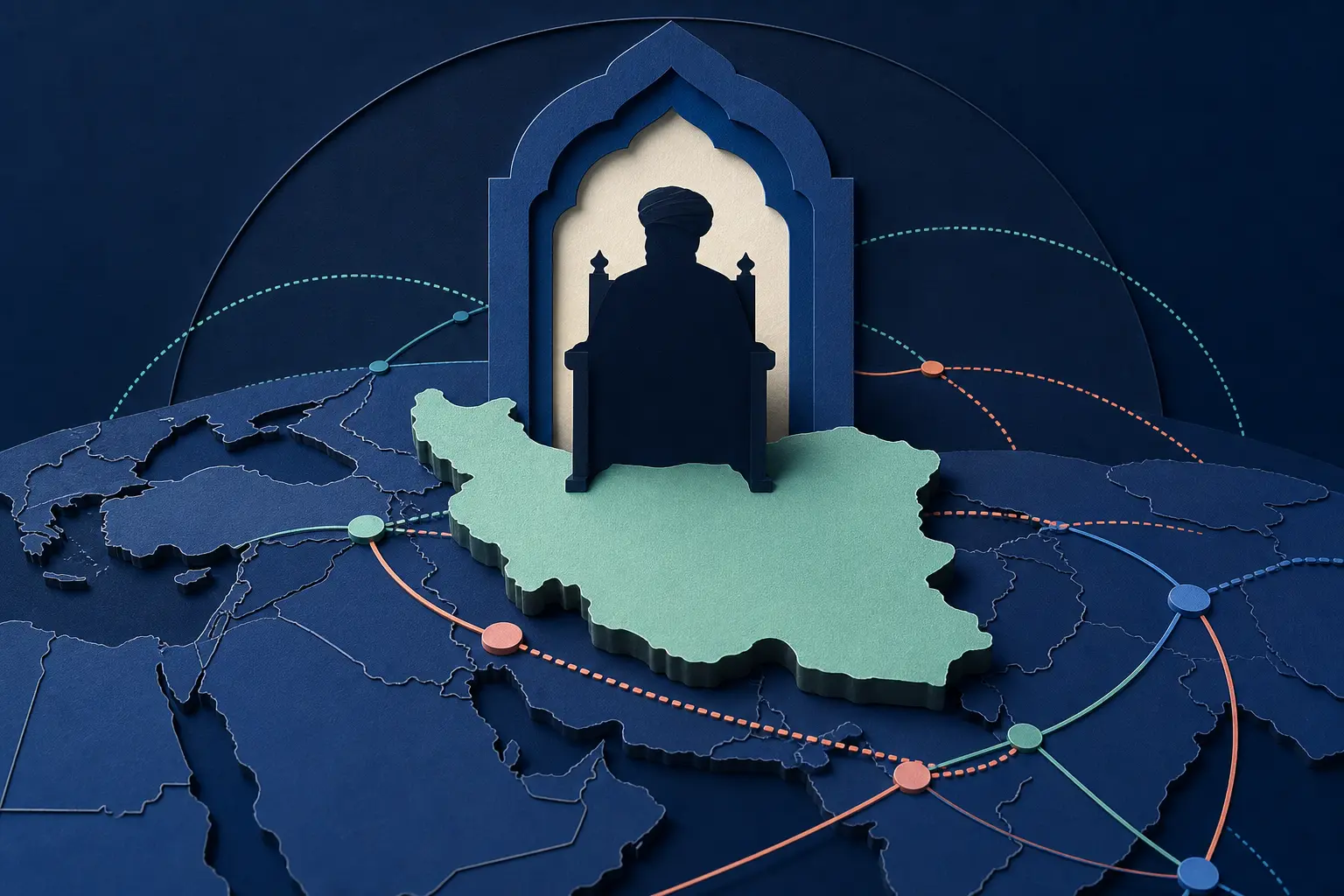
Will Mojtaba Khamenei be Iran's de facto head of state at the end of 2026?
chance the market gives this event — not your chance of being right
- Yes — The event happens
- 79%
- No — The event does not happen
- 21%
Trade this contract
In short
The market treats this as unlikely. The contract requires two things to happen in sequence before the end of the year — Ali Khamenei ceasing to exercise power, and his son emerging as the person who actually controls the armed forces, the security services and the state administration — and traders are pricing the combination, not either step alone. A confirmed transition at the top, followed by reporting that placed Mojtaba Khamenei at the centre of decision-making in Tehran, would move this faster than any other single development.
How the contract works
Probability
How the price has moved
Context
Analysis
What moves the probability
Whether a transition happens at all in 2026
This is the dominant variable. If Ali Khamenei is still exercising the powers of the office on 31 December 2026, the contract resolves NO regardless of how strong his son's position looks. Every day without a transition mechanically pulls the probability down, which is why a flat, low price is the market's default state here.
The IRGC and the security services
Settlement follows effective control of the capital, the armed forces and the state administration, not clerical endorsement. If the Revolutionary Guard leadership and the intelligence services back a single candidate quickly, the no-identifiable-leader branch collapses and one name rises sharply. If they split, the market shifts toward ambiguity rather than toward any individual.
Clerical eligibility and legitimacy
The Assembly of Experts is the formal selector, and objections to a leader's religious standing have been the traditional obstacle to Mojtaba Khamenei. In 1989 the constitution was amended to solve exactly this problem, so it is surmountable — but the need to manage it adds delay and creates space for compromise candidates such as Alireza Arafi. This driver caps the upside on a fast, clean YES.
External pressure and strike risk
Renewed Israeli or American military action against Iran cuts in two directions. It can accelerate a leadership change, which raises the probability of any successor contract, but it also raises the chance of a fragmented outcome in which no single figure demonstrably controls the state. Escalation therefore widens the distribution more than it lifts this specific contract.
How reporting is worded
Because settlement rests on major international news agencies describing who exercises primary governing authority, the phrasing of that coverage matters. A transition in which a formal successor is named but power visibly sits with a council or a military command could produce a genuinely contested reading. This ambiguity risk keeps some weight on the no-identifiable-head-of-state contract and away from named individuals.
The case for
- Ali Khamenei was born in 1939 and has held the office since 1989, so an actuarially ordinary event inside the next five months is enough to open the question.
- Mojtaba Khamenei's reported position inside his father's office and his ties to parts of the security establishment give him a route to the two things settlement actually measures: control of the armed forces and of the state administration.
- The 1989 succession showed the Iranian system can install and legitimise a leader within days, including by amending the eligibility rules, so a fast consolidation is not without precedent.
- If a transition happens and the Revolutionary Guard leadership settles quickly on one name, international agencies would likely describe that person as running Iran well before 31 December 2026.
The case against
- The simplest path to NO requires nothing to happen: if Ali Khamenei is still exercising the powers of the office on 31 December 2026, the contract pays nothing.
- Hereditary succession is politically costly in a republic founded in opposition to monarchy, and objections to Mojtaba Khamenei's clerical standing have been voiced from within the establishment for years.
- Compromise figures with stronger formal religious credentials, including Alireza Arafi, are available precisely because they avoid the dynastic problem.
- Even after a transition, a period in which power visibly sits with a council or with military command would push settlement toward the no-identifiable-head-of-state outcome rather than toward any named person.
Trade this contract
- gas covered
- no trading fee
Venues (1)
- PolymarketRecommendedYes79%0.79
- Volume (24h)
- US$282.6k
- Fee
- 0%
Probability
- Will Mojtaba Khamenei be head of state in Iran end of 2026?79%
- Will there be no Head of State in Iran end of 2026?7%
- Will Alireza Arafi be head of state in Iran end of 2026?4%
- Will Reza Pahlavi be head of state in Iran end of 2026?3%
- Will Mohammad-Bagher Ghalibaf be head of state in Iran end of 2026?1%
- Will Ahmad Vahidi be head of state in Iran end of 2026?1%
- Will Masoud Pezeshkian be head of state in Iran end of 2026?1%
- Will Hassan Rouhani be head of state in Iran end of 2026?1%
- Will Abbas Araghchi be head of state in Iran end of 2026?1%
- Will Hassan Khomeini be head of state in Iran end of 2026?0%
- Will Muhammad Mirbaqiri be head of state in Iran end of 2026?0%
- Will Mohammad Khatami be head of state in Iran end of 2026?0%
Resolution rules
Resolution is determined on Polymarket from reporting by major international news agencies on who exercises primary governing authority in Iran at 12:00 ET on 31 December 2026. The contract resolves YES only if Mojtaba Khamenei is the individual who de facto holds and exercises head-of-state powers — primary governing authority including effective control over the armed forces, state institutions and core executive decision-making — irrespective of formal title or international recognition. Formal appointment and foreign recognition are not required. Where competing claimants exist, the outcome follows whoever demonstrably controls the capital, the security services and the state administration. Parallel contracts in the same group cover Reza Pahlavi, Alireza Arafi, Masoud Pezeshkian, Hassan Rouhani and others, as well as the case in which no identifiable head of state can be established; those contracts settle from the same source and the same reading of the facts.
Calculation methodology →Local context
What to watch
Common questions
- What exactly settles this contract, and when?
- Settlement is judged as of 12:00 ET on 31 December 2026, using reporting from major international news agencies about who actually holds and exercises the powers of head of state in Iran on that day. The test is effective control over the armed forces, state institutions and core executive decision-making. A formal title, an official appointment and foreign recognition are all explicitly not required.
- If Ali Khamenei is still in charge at the end of the year, what happens?
- The contract resolves NO. This question asks who is exercising governing authority on 31 December 2026, so any outcome in which the incumbent is still doing so pays nothing on the Mojtaba Khamenei contract. That is the single largest reason the price sits low.
- What does the current price actually mean?
- It is the market's estimate of the chance that this specific outcome occurs, expressed as a price between zero and $1. A contract at 0.30 implies roughly a three-in-ten chance; one at 0.05 implies the market treats it as a tail outcome. It is a probability, not a forecast anyone is committed to defending.
- Why do the readings in this event range so widely?
- The figures span several linked contracts covering different candidates and the scenario in which no single person can be identified as running Iran. One of those contracts was trading near 79 per cent while several others sat at or close to zero, which produces a headline spread of about 79 percentage points. It reflects the structure of the group, not disagreement about Mojtaba Khamenei.
- What if the situation is ambiguous or contested on the settlement date?
- The rules address that directly: if rival claimants exist, settlement follows whoever demonstrably controls the capital, the security services and the state administration. If no one meets that test, the separate no-identifiable-head-of-state contract in the group is the relevant outcome. Ambiguity is therefore priced as its own branch rather than resolved by guesswork.
- Who formally chooses Iran's supreme leader?
- The Assembly of Experts, an 88-member elected clerical body, selects the leader under the constitution. In 1989 it chose Ali Khamenei within a day of Khomeini's death, after the constitution was amended to remove the requirement that the leader be a senior source of religious authority. In practice the Revolutionary Guard and the leader's own office heavily shape who is viable.