Menu
Politics

Will a Democrat win the 2026 Wisconsin governor race?

Resolution: Updated:

In short

The market treats a Democratic win as the clear favorite, though not a certainty, in a state that has decided recent statewide races by a point or two. The main reason is Wisconsin's recent voting pattern for governor combined with the historic tendency of the party out of the White House to do well in midterms. That confidence would erode fast if a strong, well-funded Republican nominee consolidates the primary field early, or if a national swing toward Republicans shows up in generic-ballot polling through 2026.

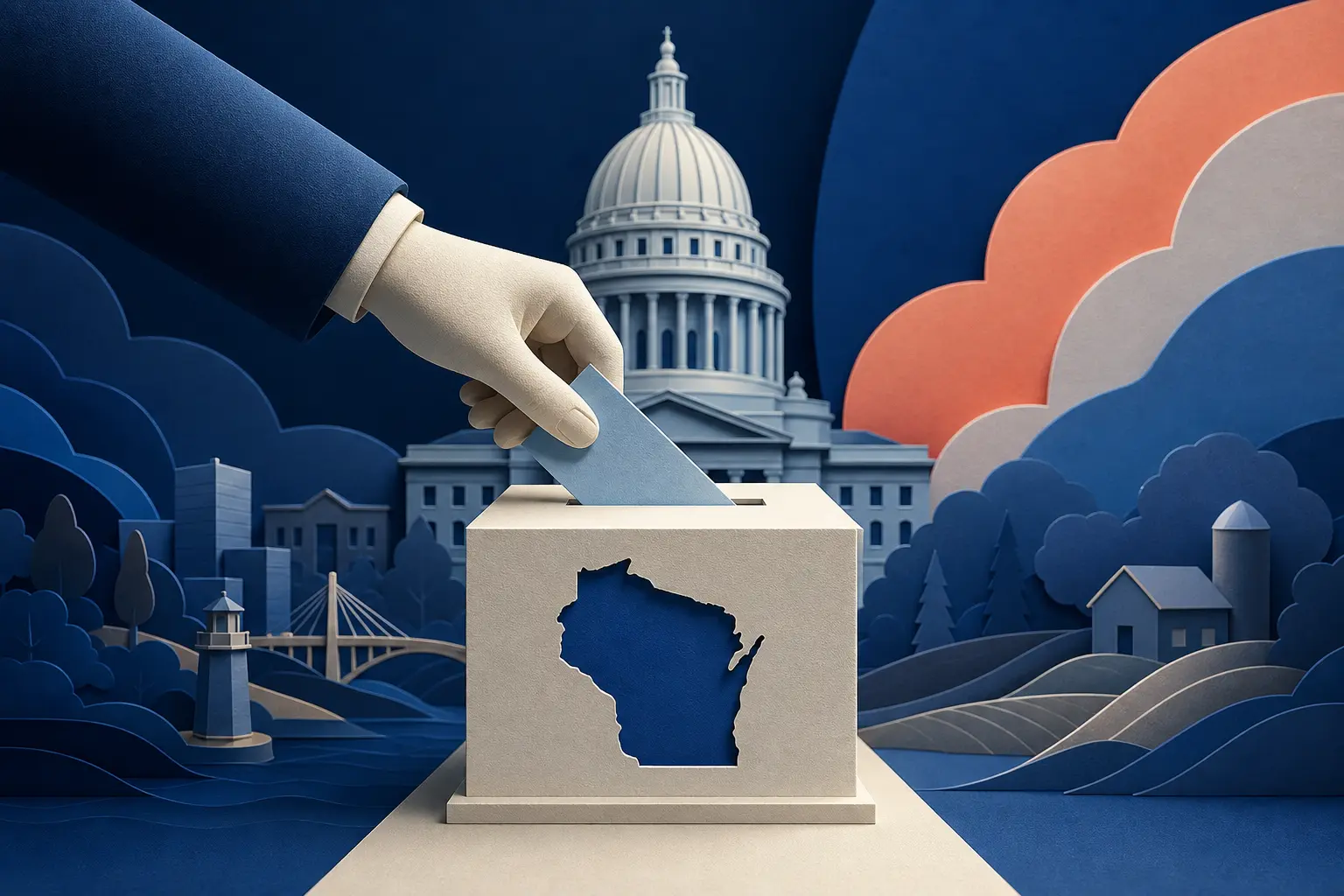
Editorial illustration for: Will a Democrat win the 2026 Wisconsin governor race?

How the contract works

A contract on this market settles at $1 per share if the Democratic nominee wins the November 2026 Wisconsin gubernatorial election, and at $0 if a Republican, independent, or third-party candidate wins instead. The price at any moment reflects what buyers and sellers currently think the chance of a Democratic win is โ€” a contract trading at 0.30, for example, would imply the market sees roughly a three-in-ten chance, not that anyone has predicted the outcome with certainty. The market settles based on the race being called for one candidate by the Associated Press, Fox News, and NBC; if those three disagree, official certification from the state of Wisconsin governs instead. A position in this market can typically be sold before 3 November 2026 at whatever price the market has moved to by then, rather than held all the way to settlement.
What the market thinks happens
$100
Yes82%

The event happens

Costs now
$0.82
If you put in $100
$122
No18%

The event does not happen

Costs now
$0.18
If you put in $100
$556

Probability

History starts collecting once the event is tracked

How the price has moved

The market currently prices a Democratic win at 82%, based on trading concentrated entirely on Polymarket with $202,282 in volume. No breakdown of the day-to-day or week-to-week path of that price has been reported, so it is not possible to identify a specific news event that moved it to this level; what can be said is that the price is being set by a single venue rather than a consensus across competing markets, which tends to make it more sensitive to the actions of individual large traders than a market split across several venues would be.

Analysis

Context

Wisconsin holds its next gubernatorial election on 3 November 2026. Tony Evers, the Democratic incumbent first elected in 2018 and reelected in 2022, has indicated he will not seek a third term, which turns this into an open-seat race rather than a referendum on an incumbent. That matters because open-seat elections in swing states tend to be closer and more volatile than re-election contests, since neither party can rely on incumbency advantages like name recognition or a sitting governor's approval rating. Wisconsin's statewide elections have been decided by razor-thin margins for the better part of two decades. Evers beat Republican Tim Michels by about 3.4 points in 2022, and the state's 2024 presidential vote was decided by less than one point. Control of the governor's office matters beyond Wisconsin itself: the governor holds veto power over legislation passed by a Republican-controlled state legislature, appoints the state's election administration leadership, and Wisconsin remains one of a small number of states expected to decide the 2028 presidential election. Since 2002, Wisconsin has elected a Democratic governor in four of six gubernatorial contests โ€” Jim Doyle in 2002 and 2006, then Evers in 2018 and 2022 โ€” with Republican Scott Walker winning in 2010 and 2014. That pattern of alternating but Democrat-leaning outcomes forms part of the backdrop against which this market is pricing the 2026 race.
The market-implied probability across tracked venues currently sits at 82% for a Democratic win, built on $202,282 in trading volume so far, all of it on Polymarket, the only venue currently listing this contract. Because there is only one venue, there is no cross-venue spread to read for disagreement โ€” the entire signal comes from how one pool of traders has priced a single, still-distant election more than a year out. The historical case for the 82% level rests on Wisconsin's recent gubernatorial record: Democrats have won four of the last six governor's races since 2002, including both of Evers's wins in 2018 and 2022. But that same history argues for caution about pricing this much higher, since every one of those Democratic wins, and both of Walker's Republican wins before them, came by single-digit margins. Wisconsin does not produce blowouts in statewide races; it produces margins measured in tens of thousands of votes, as seen in the 2024 presidential contest decided by under a point. The open-seat nature of the 2026 race adds genuine uncertainty that a simple read of past Democratic success understates. Evers's decision not to seek a third term removes an incumbent with two prior statewide wins and forces both parties into fresh primary contests, the outcomes of which will shape how competitive November actually becomes. Midterm history offers Democrats a tailwind in principle โ€” the party outside the White House typically gains ground in midterm elections โ€” but that pattern does not guarantee a specific state outcome, particularly one as narrowly divided as Wisconsin.

What moves the probability

  1. Open seat, no incumbent

    Evers not seeking a third term means neither party can lean on incumbency advantages such as name recognition or an approval-rating cushion. This raises the variance of the race relative to 2022 and pulls the probability away from the extremes toward a more competitive range.

  2. Wisconsin's razor-thin statewide margins

    The 2022 governor's race was decided by about 3.4 points and the 2024 presidential vote by less than one point. This history caps how confident the market can reasonably be in either direction and explains why the price sits well short of near-certainty despite Democratic dominance since 2002.

  3. Midterm-year national mood

    Parties outside the White House have historically performed well in midterm elections, which would favor Democrats in November 2026. This is a real but probabilistic tailwind, not a guarantee tied to Wisconsin specifically.

  4. Democratic statewide track record since 2002

    Democrats have won four of the last six Wisconsin gubernatorial elections. This recent history supports the market's lean toward a Democratic win but does not account for the unpredictability an open primary introduces on both sides.

  5. Single-venue pricing

    With all $202,282 of tracked volume on one venue, the 82% figure reflects one pool of participants rather than a consensus formed across competing markets. A thin, single-venue market can move more sharply on new information than one with broader participation.

The case for

  • The Democratic nominee wins if the party's statewide infrastructure and recent electoral record, four wins in six gubernatorial races since 2002, carries into 2026.
  • A national midterm environment favoring the party outside the White House would need to translate into Wisconsin turnout and persuasion, as historical midterm patterns suggest is plausible.
  • The Democratic primary would need to produce a nominee capable of holding the same coalition that delivered Evers's 2018 and 2022 wins, despite his absence from the ticket.
  • AP, Fox News, and NBC would need to call the race for the Democratic nominee, or state certification would need to confirm that outcome if the networks disagree.

The case against

  • Wisconsin's governor races have been decided by single-digit margins for two decades, and an open seat removes the incumbency advantage that helped Evers win by only 3.4 points in 2022.
  • A strong, well-funded Republican nominee emerging from the primary could consolidate support the way Walker did in 2010 and 2014.
  • The 2024 presidential result, decided by less than one point in Wisconsin, shows the state's electorate remains closely split heading into 2026.
  • A shift in the national political environment away from Democrats between now and November 2026 would undercut the midterm tailwind the market currently appears to be pricing in.

What to watch

The next concrete catalysts are the Wisconsin party primaries, which will determine the actual nominees rather than leaving the race as a generic partisan matchup, followed by fundraising disclosures and any statewide polling released through 2026. National midterm indicators, including generic congressional ballot polling and any special elections held before November 2026, will offer signals about the broader environment Wisconsin's race is embedded in. The final resolution event is the election itself on 3 November 2026, followed by the AP, Fox News, and NBC calls, with Wisconsin's official certification as the fallback if those three disagree.

Trade this contract

Venues (1)

More about this event

Venues (1)

Probability

  • Will the Democrats win the Wisconsin governor race in 2026?82%
  • Will the Republicans win the Wisconsin governor race in 2026?20%

Resolution rules

Determined by
Associated Press, Fox News, NBC call; official Wisconsin certification if needed
Resolution date

This market resolves Yes if the Democratic nominee wins the Wisconsin gubernatorial election held on 3 November 2026, and No otherwise. Resolution is based on the race being called for the same candidate by the Associated Press, Fox News, and NBC; if those three sources disagree, official certification from the state of Wisconsin governs. Independent or third-party candidates do not count as either a Democrat or a Republican for settlement purposes.

Calculation methodology โ†’

Local context

For readers outside Wisconsin, the connection runs through the state's status as one of a handful of places expected to decide the 2028 presidential election; whichever party controls the governor's office going into that cycle will shape ballot access rules, election administration, and the political signal the state sends nationally. It also matters to anyone tracking the balance of power in state governments, since a Wisconsin governor holds veto authority over a Republican-controlled legislature and appoints the officials who run the state's elections.

Common questions

What exactly settles this market, and when?
The market resolves based on the outcome of the Wisconsin gubernatorial election held on 3 November 2026. It settles Yes if the Democratic nominee wins, based on the race being called for that candidate by the Associated Press, Fox News, and NBC; if those three disagree, official certification from the state of Wisconsin governs instead.
What does the market price actually mean?
The price is the market's current estimate of the probability of a Democratic win, expressed on a scale where $1 is paid if the outcome happens and nothing if it does not. A price of 0.60, for instance, would mean the market sees roughly a six-in-ten chance, not a prediction stated with certainty.
Is Tony Evers running for a third term?
Evers has indicated he will not seek reelection in 2026, which makes this an open-seat race rather than a contest involving a sitting governor. That removes the incumbency advantage that helped him win in 2018 and 2022.
What happens if the networks call the race for different candidates?
If AP, Fox News, and NBC do not agree on who won, the market falls back on official certification by the state of Wisconsin to determine the result. This is the same fallback used across most US election markets when network calls diverge.
Why is Wisconsin considered such a closely fought state?
Wisconsin's statewide elections have repeatedly been decided by margins under four points, including a 3.4-point governor's race in 2022 and a sub-one-point presidential result in 2024. That history is why the market prices this race well short of a near-certainty despite a Democratic-leaning recent record.
Do independent or third-party candidates count toward the Democratic side?
No. The market resolves Yes only if the Democratic Party's nominee wins; a win by an independent or third-party candidate resolves the market No, regardless of that candidate's ideological leanings.

Related events