Menu
World

Will the US carry out a military strike on Cuba by the end of 2026?

Resolution: Updated:

In short

The market treats a US strike on Cuban territory this year as unlikely, closer to a long shot than a toss-up. That reading rests mainly on the narrow definition of what counts as a strike and the absence of any publicly reported US military target inside Cuba as of 10 November 2026. A reported drone, missile or air strike hitting Cuban soil, or a claim of one from Donald Trump or his administration, would change that reading immediately.

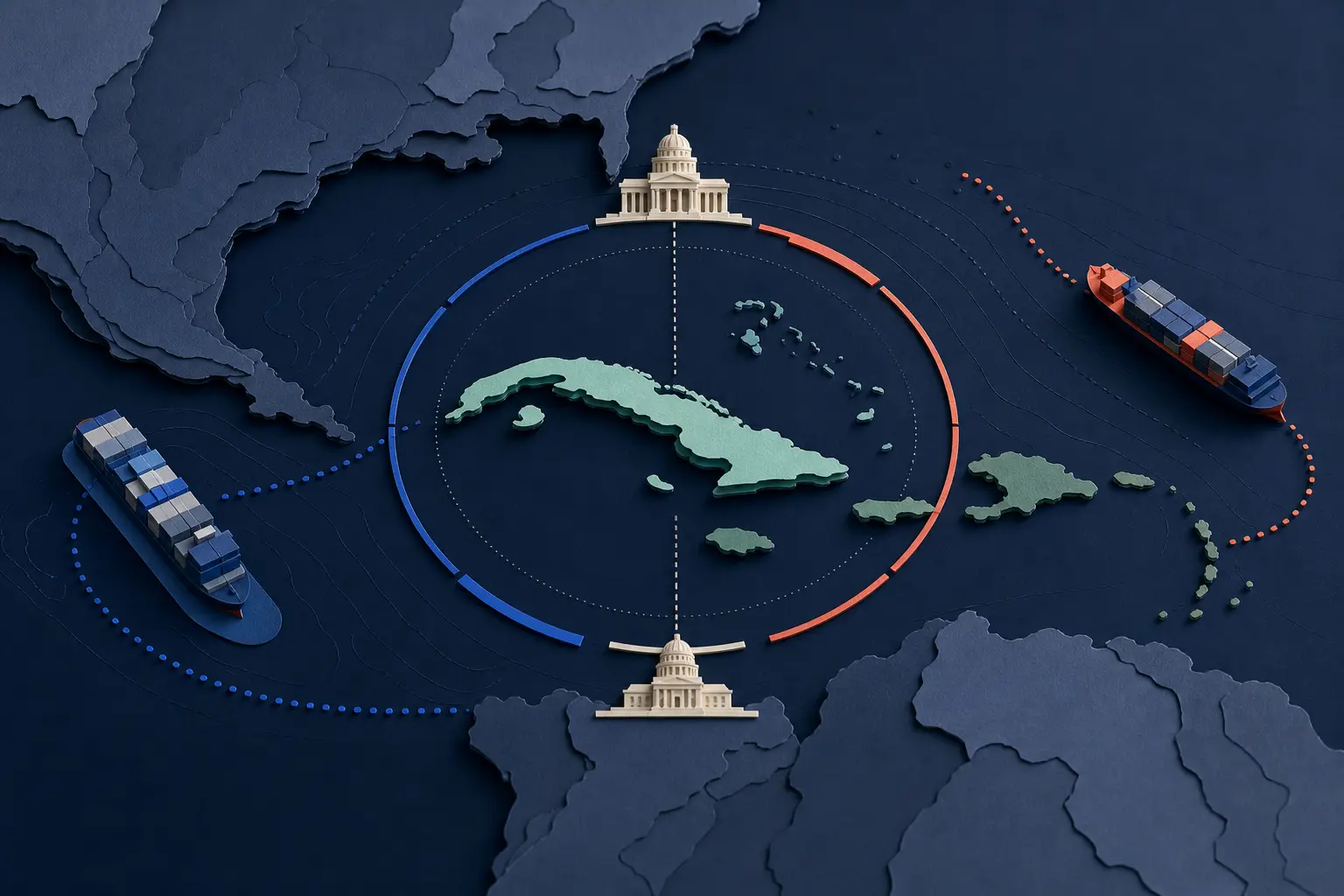
Editorial illustration for: Will the US carry out a military strike on Cuba by the end of 2026?

How the contract works

A contract on this market settles at $1 if a US-initiated drone, missile or air strike physically hits Cuban land, rivers, lakes or ports by 31 December 2026, and at nothing if that does not happen. The price at any moment is simply the collective view of buyers and sellers on how likely that is: a contract trading at 0.30, for instance, would imply roughly a three-in-ten chance, not a certainty either way. Settlement is based on credible reporting or official confirmation from the US government or the Trump administration, and the market resolves on 1 January 2027 for anything that happened by the end of the prior day. A position bought today does not have to be held to settlement; it can be sold at whatever price the market shows at any point before then.
What the market thinks happens
$100
Yes9%

The event happens

Costs now
$0.09
If you put in $100
$1,111
No91%

The event does not happen

Costs now
$0.91
If you put in $100
$110

Probability

History starts collecting once the event is tracked

How the price has moved

The only venue tracking this question, Polymarket, prices it at 9% on $5.5 million in volume. That volume is substantial for a single-venue geopolitical tail-risk market, indicating the question has drawn sustained rather than passing attention, likely tied to the broader Venezuela campaign rather than to any reported Cuba-specific plan. Detailed day-to-day or week-to-week move data is not available here, so no single news event can be credited with shifting the price; what can be said is that the current level reflects a market that, for now, keeps the probability in single digits rather than treating a strike on Cuban territory as a near-term likelihood.

Analysis

Context

This market asks whether the United States will physically strike Cuban territory with a drone, missile or air strike before 31 December 2026. It sits against a backdrop of rising US military activity in the wider Caribbean: the Trump administration has carried out strikes against vessels it describes as drug-trafficking boats and has deployed naval assets toward Venezuela as pressure on Nicolรกs Maduro's government has grown. Cuba is Venezuela's closest regional ally and has long depended on Caracas for subsidized oil, which ties the two governments together in Washington's thinking. Cuba itself has no formal diplomatic relationship with Washington that could absorb a crisis. The US embargo has run since the early 1960s, and in January 2025 the Trump administration reversed a late Biden-era decision and re-designated Cuba a state sponsor of terrorism, restoring a harder sanctions posture. None of that amounts to evidence of an imminent strike, but it sets a backdrop in which rhetoric between Washington and Havana runs hot even without a specific trigger. No US official has publicly named Cuba as a strike target as of this writing. The question exists because of the Venezuela campaign's trajectory and the possibility that it widens, not because of a reported Cuba-specific plan.
The consensus price of 9% across $5.5 million in trading volume, all of it on a single venue, Polymarket, tells a fairly specific story. There is no second venue to compare against, so there is no spread to read for disagreement between pools of traders โ€” the number reflects one order book's accumulated view, built up over enough volume to suggest sustained rather than fleeting interest in the question. A tail-risk geopolitical market pulling in $5.5 million indicates traders are treating this as a live possibility worth pricing carefully, not a throwaway curiosity, even while keeping the probability in single digits. The resolution rules do a lot of the work in keeping that number low. The contract only pays out on a drone, missile or air strike that physically impacts Cuban territory. Explicitly excluded are intercepted munitions, surface-to-air missile fire, artillery, small arms fire, ground incursions, naval shelling and cyberattacks โ€” a long list of lower-intensity actions that could plausibly occur in an escalating standoff without ever triggering a Yes. That narrows the path to resolution considerably: friction, overflights, naval posturing or even an exchange of fire that stops short of a US-initiated strike on Cuban soil would not settle this market, which pushes the implied probability down relative to a looser definition of "conflict." Working in the other direction is the automatic-trigger clause: any strike claimed by Trump or the US government during the window counts as Yes regardless of independent corroboration. Given the administration's pattern of announcing military actions in the Caribbean and Venezuela theatre directly and publicly, this clause means the market is pricing not just the chance of an actual strike but the chance of a public claim of one โ€” a lower bar that keeps the probability from falling even further. The absence of a named Cuba-specific target or operation in public reporting, as distinct from the Venezuela-focused activity that has dominated coverage, is the single biggest reason the number sits in the single digits rather than higher. Strikes on drug-trafficking vessels and pressure on Maduro's government are a different category of action than a strike on Cuban territory itself, and the market appears to be pricing the distance between those two things rather than treating them as the same story.

What moves the probability

  1. Venezuela spillover risk

    Cuba's dependence on Venezuelan oil and its political alignment with Maduro's government mean any major US escalation against Caracas carries some chance of extending to Havana. This is the main upward pressure on the price, but it remains indirect since no reported US operation has named Cuba as a target.

  2. Narrow strike definition

    The rules exclude naval shelling, artillery, small arms fire, ground incursions and intercepted munitions, meaning most forms of military friction short of an actual drone, missile or air strike on Cuban soil do not resolve the market Yes. This narrows the path to resolution and is the largest downward pressure on the price.

  3. Automatic trigger on an official claim

    Any strike claimed by Trump or the US government counts as Yes regardless of independent verification. Given the administration's pattern of announcing Caribbean military actions publicly, this keeps the probability from falling as low as the strict physical-strike definition alone might suggest.

  4. State sponsor of terrorism re-designation

    The January 2025 decision to restore Cuba's listing as a state sponsor of terrorism raised the diplomatic temperature between Washington and Havana. It sets a harder backdrop for any future crisis but has not itself been accompanied by reported military planning against Cuba.

  5. Absence of a named target

    No US official statement or credible report as of 10 November 2026 identifies a specific Cuban target or operation. This absence is the clearest reason the price sits where it does; a leak or announcement naming Cuba directly would be the fastest way to move it.

The case for

  • Cuba's political and economic ties to Venezuela's Maduro government mean a widening US campaign in the Caribbean carries some chance of reaching Cuban territory before 31 December 2026.
  • The rules count any strike claimed by Trump or his administration automatically, so a single public statement, even about a limited operation, would be enough to resolve the market Yes without further verification.
  • The administration has already shown a willingness to use kinetic force unilaterally against targets in the Caribbean theatre, including strikes on vessels it describes as drug-trafficking boats, establishing a precedent for action in the region.
  • Sustained trading volume of $5.5 million on a single venue suggests market participants see this as more than a remote possibility worth pricing carefully.

The case against

  • No US official has publicly named Cuba as a strike target as of 10 November 2026, and the market's low price largely reflects that absence.
  • The rules exclude naval shelling, artillery, small arms fire, ground incursions and intercepted munitions, so a wide range of plausible friction between the two countries would not settle the market Yes.
  • A direct strike on Cuban territory would mark a significant escalation beyond the drug-interdiction operations reported in the wider Caribbean so far, carrying diplomatic and legal costs that have so far kept US action confined to Venezuela-linked targets at sea.
  • The 9% consensus price across the only venue tracking this question indicates the market itself treats a strike within the year as a minority outcome rather than a probable one.

What to watch

The clearest triggers between now and 31 December 2026 are any US statement naming Cuba directly as a military target, any reported drone, missile or air strike on Cuban land, rivers, lakes or ports, and any claim from Trump or his administration of such an action, which would settle the market automatically regardless of corroboration. Beyond that, developments in the Venezuela standoff are the variable most likely to spill over: further US naval deployments to the Caribbean, additional strikes on vessels described as drug-trafficking boats, and any formal change in Washington's posture toward Maduro's government all bear watching as indirect signals for Cuba risk. The resolution date is 1 January 2027, settling everything that happened by 31 December 2026.

Trade this contract

Venues (1)

Open on PolymarketYes 0.09
  • gas covered
  • no trading fee

More about this event

Venues (1)

Resolution rules

Determined by
Polymarket; based on credible reporting or official US government/Trump administration confirmation of a strike
Resolution date

Resolution is determined by Polymarket based on credible reporting or official confirmation from the US government or the Trump administration. The market resolves Yes if a US-initiated drone, missile or air strike physically impacts Cuban territory, including land, rivers, lakes or ports, at any point up to 31 December 2026. Intercepted munitions, surface-to-air missile strikes, artillery, small arms fire, ground incursions, naval shelling and cyberattacks are explicitly excluded and do not trigger Yes. Any strike claimed by Donald Trump or the US government during the window qualifies automatically, regardless of independent verification. The market settles on 1 January 2027.

Calculation methodology โ†’

Local context

For a US audience this is a direct question about where the Trump administration is prepared to use military force and how far a domestic political fight over war powers and Caribbean policy might extend. For readers in the UK, Canada, Australia and elsewhere who follow US foreign policy and markets, a strike on Cuban territory would be a major geopolitical event with immediate implications for US alliances, sanctions policy, and risk sentiment in markets that already track the Venezuela standoff closely. It also carries domestic political weight inside the US given the size and influence of the Cuban-American community, particularly in Florida, which has historically shaped US policy toward Havana regardless of which party controls the White House.

Common questions

What exactly settles this market and when?
It resolves Yes if a US-initiated drone, missile or air strike physically impacts Cuban land, rivers, lakes or ports by 31 December 2026, based on credible reporting or official confirmation from the US government or the Trump administration. It resolves No if that has not happened by then. Settlement occurs on 1 January 2027.
What does the market price actually mean?
The price is the market's collective estimate of the chance the strike happens, expressed as a number between 0 and 1. A price of 0.20, for example, would mean the market sees roughly a one-in-five chance, not a guarantee of either outcome.
What counts as a qualifying strike under the rules?
Only a drone, missile or air strike that physically hits Cuban territory counts. Intercepted munitions, surface-to-air missile fire, artillery, small arms fire, ground incursions, naval shelling and cyberattacks are explicitly excluded, even if they occur in a clearly escalating confrontation.
What happens if a strike is claimed but not independently verified?
Any strike claimed by Donald Trump or the US government during the window automatically qualifies for Yes resolution, regardless of separate confirmation. Outside of such a claim, the market relies on credible reporting to establish that a strike occurred.
Why is Cuba connected to the Venezuela situation at all?
Cuba depends heavily on subsidized Venezuelan oil and is politically aligned with Maduro's government, which has made Havana a secondary concern as US pressure on Caracas has intensified. Cuba was also re-designated a state sponsor of terrorism by the Trump administration in January 2025, reversing a late Biden-era removal and hardening the diplomatic backdrop.
Could this market resolve before 31 December 2026 if a strike happens earlier?
The market tracks whether a qualifying strike occurs at any point up to 31 December 2026, so an earlier strike would settle it Yes immediately upon credible confirmation rather than waiting for the deadline.

Related events