Menu
Economy

Will the United States announce a ban on diesel exports by 31 October 2026?

Resolution: Updated:

In short

The market treats a full US diesel export ban as unlikely before 31 October 2026. Diesel inventories and refining output have not reached the kind of crisis level that has previously pushed Washington to even discuss export limits, and officials have historically reached for softer tools first. That would change quickly if refinery outages, a hurricane hitting Gulf Coast capacity, or a sharp domestic price spike forced an emergency response before the deadline.

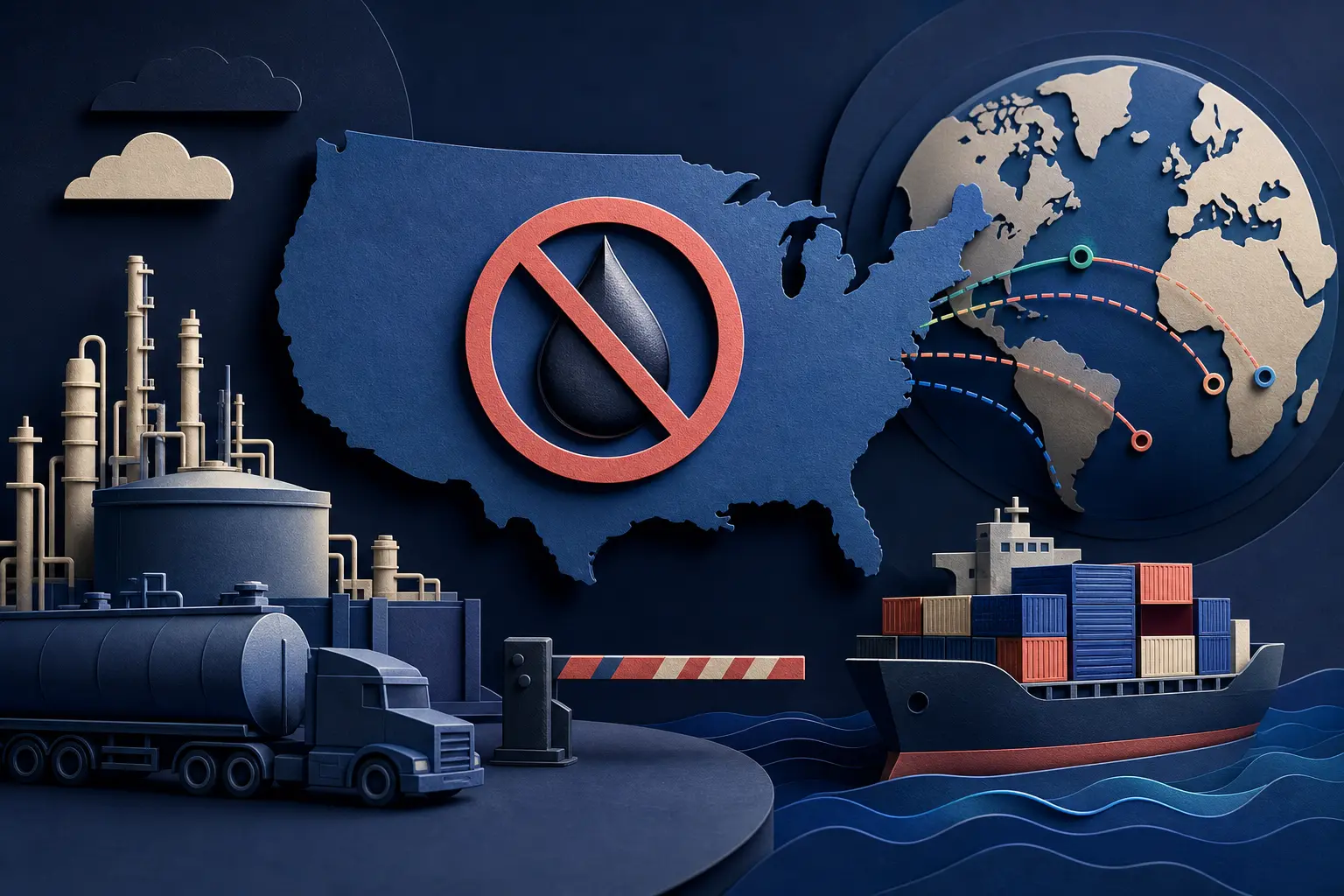
Editorial illustration for: Will the United States announce a ban on diesel exports by 31 October 2026?

How the contract works

A contract on this question settles at $1 if the United States officially announces a full or substantially complete ban on diesel exports before 31 October 2026, 11:59 PM ET, and at $0 if no such announcement is made. The announcement has to come from the President, the White House, a Cabinet member, or an authorized federal agency, and it has to amount to an outright prohibition rather than a quota, tariff, licensing requirement, or a ban aimed at specific countries. If a contract were priced at 0.30, that would mean the market judged the chance of such a ban at roughly three in ten; the actual price for this market is shown alongside this text and changes as new information arrives. Positions can typically be bought or sold before the 1 November 2026 resolution date at whatever price the market is quoting at that moment.
What the market thinks happens
$100
Yes21%

The event happens

Costs now
$0.21
If you put in $100
$476
No79%

The event does not happen

Costs now
$0.79
If you put in $100
$127

Probability

History starts collecting once the event is tracked

How the price has moved

The contract is currently pricing this event at 12% on Polymarket, the sole venue trading it, on volume of $124,214. No additional historical range or day-over-day move figures are available for this market, and no single publicly reported catalyst explains the current level; instead, the price appears to reflect a standing baseline probability drawn from the 2022 precedent, adjusted down by the absence of any comparable inventory or refinery crisis so far in 2026.

Analysis

Context

The United States is one of the world's largest exporters of diesel and other distillate fuel, shipping large volumes to Europe and Latin America, markets that lean on US refiners partly because of sanctions on Russian refined products. Domestic diesel prices matter politically because diesel powers trucking, farming and heating oil in parts of the Northeast, so a price spike shows up quickly in freight costs and household heating bills. The last time this idea got serious attention in Washington was in 2022, when low distillate inventories on the East Coast, amplified by the disruption to global refined product flows after Russia's invasion of Ukraine, led officials to publicly weigh restricting fuel exports. The administration at the time chose to release reserves and lean on refiners rather than impose an outright ban, and no prohibition followed. This market asks whether that pattern breaks in 2026. It settles based on public statements from the President, the White House, a Cabinet member, or an authorized federal agency such as the Department of Energy or Commerce. Anything short of a full or near-full prohibition, including quotas, tariffs, licensing rules or bans limited to specific destinations, does not count as a Yes.
The market-implied probability sits at 12% on Polymarket, the only venue currently trading this contract, with $124,214 in total volume changing hands. Both figures matter for reading the price. A 12% level says the market sees a diesel export ban as a real but distinctly minority possibility, not a fringe scenario and not a coin flip. The relatively modest volume for a macro-policy contract suggests this is a thinly traded market where a handful of large positions can move the price noticeably, so the number should be read as a rough consensus rather than a tightly calibrated forecast built on deep liquidity. The core reason the probability sits in the low double digits rather than near zero is that the underlying scenario is not hypothetical. The US has come close to this exact policy before. In 2022, distillate stocks on the East Coast fell to levels that alarmed officials, and an export restriction was discussed at a senior level before being shelved in favor of Strategic Petroleum Reserve releases and informal pressure on refiners. That episode establishes that the tool is on the table in a genuine supply squeeze, which is why the market does not price this at zero. What keeps the number low is that the same episode also shows the bar for actually pulling the trigger is high. An outright export ban would cut into refiners' margins on their most profitable product lines, complicate relations with allies who depend on US diesel, including several in Europe replacing Russian refined product, and risks retaliation or supply disruption elsewhere. Administrations have consistently preferred narrower measures, quotas, informal jawboning, inventory releases, precisely the tools this contract's rules explicitly exclude from counting as a Yes. Without a documented spike in EIA distillate inventory data or a refinery outage on the scale of a major Gulf Coast hurricane, there is no current catalyst forcing the administration's hand before the 31 October deadline. That absence of an active trigger, more than any single data point, is what anchors the price where it is.

What moves the probability

  1. Distillate inventory levels

    The EIA's weekly petroleum status report tracks US distillate stocks; a sustained drawdown toward the kind of multi-year lows seen in 2022 would push the probability up because it recreates the exact conditions that last brought an export ban into serious discussion. Stable or rising inventories push the other way and support the current low pricing.

  2. Refinery disruptions

    A hurricane or major unplanned outage hitting Gulf Coast refining capacity during the remaining Atlantic storm season could tighten domestic supply quickly and is the most plausible near-term shock that could move this probability higher before the 31 October deadline.

  3. 2022 precedent for restraint

    When distillate stocks were historically low in 2022, officials discussed export limits but ultimately used reserve releases and informal pressure instead of a ban. That precedent argues for restraint again and is a significant reason the market is not pricing this higher.

  4. Diplomatic and trade cost

    A full ban would squeeze European and Latin American buyers who rely on US diesel, some of them replacing sanctioned Russian refined product; the diplomatic and economic cost of that move is a standing argument against a ban and weighs on the probability.

  5. Domestic price politics

    A sharp rise in pump or heating-oil prices heading into the winter heating season would raise political pressure on the White House to act, and could shift sentiment toward tighter measures, even if a full ban remains the least likely of the available tools.

The case for

  • EIA distillate inventory data shows a sustained drawdown comparable to or worse than the lows seen in 2022.
  • A major refinery outage, whether from a hurricane or an unplanned shutdown, removes meaningful Gulf Coast diesel production capacity before the end of October.
  • Domestic diesel or heating-oil prices rise sharply enough to generate significant political pressure ahead of winter.
  • The White House, a Cabinet member, or an authorized agency such as the Department of Energy or Commerce issues a public statement describing the measure as an outright prohibition rather than a quota or licensing rule.

The case against

  • US distillate inventories remain within a normal range through October, removing the immediate pressure that drove the 2022 discussion.
  • The administration again favors narrower tools, such as quotas, tariffs, or reserve releases, none of which would satisfy this contract's settlement rules.
  • A full export ban risks straining relations with European and Latin American buyers who depend on US diesel, some replacing sanctioned Russian supply, raising the diplomatic cost of the move.
  • No refinery outage or storm-driven supply shock materializes before the 31 October 2026 deadline.

What to watch

The EIA's weekly petroleum status report, released every Wednesday, is the most direct gauge of whether US distillate inventories are tightening toward levels that previously triggered policy discussion. The remainder of the 2026 Atlantic hurricane season, which typically runs into November, is the main wildcard for a sudden refinery-driven supply shock. Any public statement from the Department of Energy, the Department of Commerce, or the White House referencing diesel exports, even short of a ban, would be an early signal worth tracking, as would a sharp move in retail diesel or heating-oil prices heading into the winter season.

Trade this contract

Venues (1)

More about this event

Venues (1)

Probability

  • Will the US announce a diesel export ban by October 31?21%
  • Will the US announce a diesel export ban by September 30?1%

Resolution rules

Determined by
White House and U.S. federal agency announcements (e.g., Department of Energy, Department of Commerce)
Resolution date

This resolves Yes if the President, the White House, a Cabinet member, or an authorized federal agency, such as the Department of Energy or the Department of Commerce, publicly and officially announces a prohibition on the export of diesel fuel or distillate fuel oil from the United States, whether full or covering substantially all exports, before 31 October 2026, 11:59 PM ET. Restrictions short of an outright ban, including quotas, tariffs, licensing requirements, or destination-specific bans, do not qualify and this resolves No if no qualifying announcement occurs by that deadline.

Calculation methodology โ†’

Local context

A US diesel export ban would tighten global diesel supply because the United States is one of the largest exporters of the fuel, with Europe and Latin America among the biggest buyers; a ban would likely push diesel prices higher in those markets and raise shipping and freight costs more broadly, since diesel underpins global trucking and marine transport. For US-based readers, the same policy would be aimed at lowering domestic diesel and heating-oil costs, but at the expense of refiners' export margins, a trade-off that has repeatedly stopped short of an outright ban in the past.

Common questions

What exactly settles this market, and when?
It settles based on public announcements from the President, the White House, a Cabinet member, or an authorized federal agency such as the Department of Energy or Commerce. The event resolves Yes only if a full or substantially complete prohibition on diesel exports is announced before 31 October 2026, 11:59 PM ET; the market itself resolves on 1 November 2026.
What does the current price actually mean?
The price reflects what buyers and sellers on Polymarket currently think the odds are that a diesel export ban gets announced in time. It is not a prediction from any government body or news outlet, just the aggregated view of people trading the contract.
Would a diesel quota or tariff count as a Yes?
No. The settlement rules explicitly exclude quotas, tariffs, licensing requirements, and destination-specific restrictions. Only an outright prohibition on exports, full or covering substantially all diesel exports, qualifies.
Has the US come close to banning diesel exports before?
In 2022, low East Coast distillate inventories led officials to discuss restricting fuel exports, but the administration at the time opted for Strategic Petroleum Reserve releases and pressure on refiners rather than an export ban.
What happens if the announcement comes right at the deadline or is ambiguous?
The rules require a public and official announcement before 31 October 2026, 11:59 PM ET; timing right at that cutoff would be judged against the official announcement date. An ambiguous statement that stops short of describing an outright prohibition would not satisfy the Yes condition.
Can a position in this market be exited before the resolution date?
Yes, positions can generally be bought or sold on Polymarket at the prevailing price any time before the 1 November 2026 settlement, rather than being held to the end.

Related events