Menu
World

Will Saudi Arabia's East-West oil pipeline resume operations by 30 September 2026?

Resolution: Updated:

In short

The market currently leans toward the pipeline being confirmed operational before the deadline, treating that outcome as more likely than not but not close to settled. That lean reflects Saudi Arabia's strong commercial reason to restore a route that lets it move crude to the Red Sea without transiting the Strait of Hormuz. The bigger risk to a Yes is procedural, not physical: the rule requires an explicit government statement, and Saudi authorities do not always confirm operational status on a predictable schedule.

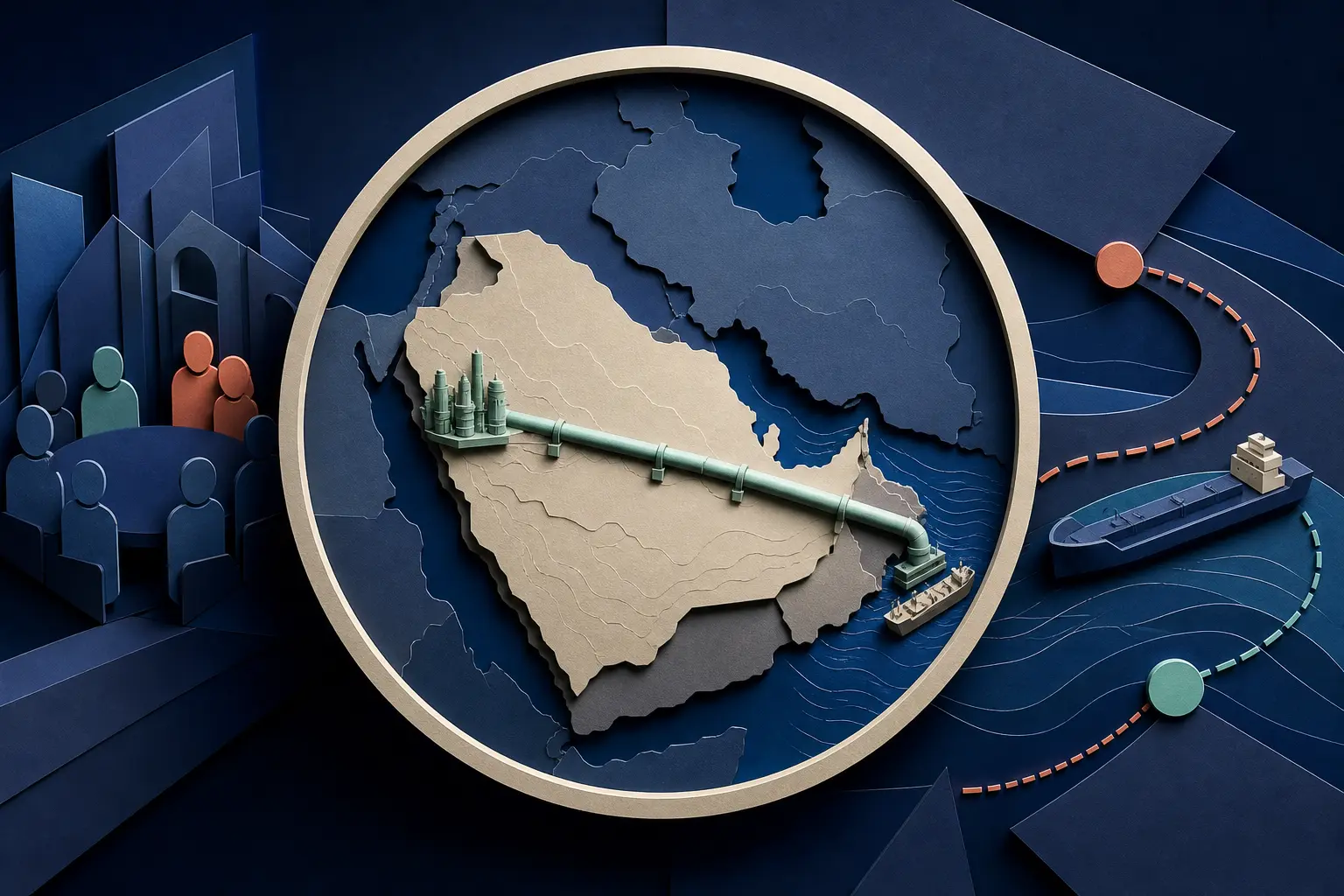
Editorial illustration for: Will Saudi Arabia's East-West oil pipeline resume operations by 30 September 2026?

How the contract works

This contract settles at $1 if the outcome happens and at nothing if it does not. It resolves Yes only if Saudi Arabia's Ministry of Energy or another official Saudi government source states, before 30 September 2026 at 11:59pm ET, that the East-West pipeline is operating again, even at reduced or partial capacity. Reports from oil traders, satellite-tracking firms, or foreign officials do not count, and neither do statements about future plans or expected timelines. The price at any moment reflects what buyers and sellers currently think that chance is; a contract priced at $0.30, purely as an illustration, would mean the market saw roughly a three-in-ten chance of an official Yes statement arriving in time. A position in this contract can generally be sold before the 1 October 2026 settlement date at whatever price the market has moved to by then.
What the market thinks happens
$100
Yes57%

The event happens

Costs now
$0.57
If you put in $100
$175
No43%

The event does not happen

Costs now
$0.43
If you put in $100
$233

Probability

History starts collecting once the event is tracked

How the price has moved

The only pricing data available places the consensus at 63% on Polymarket, the single venue currently listing this contract, with $554,289 traded to date. There is no second venue to compare it against, so no cross-market spread can be read, and no independently confirmed sequence of daily or weekly moves is available here. What can be said plainly is that $554,289 on a narrowly defined, sourced, binary geopolitical question is a moderate amount of engagement for a market with roughly a week left before its window closes, consistent with a contract that traders are actively pricing rather than ignoring.

Analysis

Context

The East-West pipeline, known inside Saudi Aramco as Petroline, runs roughly 1,200 kilometres from the Abqaiq processing complex near the Gulf coast to the Red Sea export terminal at Yanbu, with a design capacity of around 5 million barrels a day. It exists for one strategic reason: it lets Saudi Arabia move crude to tankers on the Red Sea instead of the Gulf, avoiding the Strait of Hormuz, the narrow chokepoint through which a large share of the world's seaborne oil passes and which Iran has repeatedly threatened to close during periods of regional tension.
The consensus across tracked venues sits at 63%, drawn entirely from one active market, Polymarket, which has traded $554,289 on this question. A single-venue reading is worth treating carefully: there is no second pool of capital to check it against, so the 63% is one market's aggregated view rather than a cross-checked consensus of independent traders on separate platforms. Volume in the mid-five-figures to low-six-figures range for a geopolitical contract with roughly a week left before its window closes suggests real but not heavy engagement, the kind of interest a specific, sourced, binary question about a physical infrastructure asset tends to attract rather than a broad speculative flow. What keeps the price meaningfully below certainty is the settlement design itself. The event does not ask whether the pipeline is physically carrying oil; it asks whether the Saudi government has said so on the record before a fixed cutoff. That is a narrower target than the physical question, because governments sometimes restore infrastructure quietly, for security or commercial reasons, well before or well after they choose to say so publicly. Saudi Arabia has a strong incentive to make that statement quickly if the line is genuinely back, since prolonged silence about a major export route tends to unsettle oil markets and invites speculation the government would rather pre-empt. But the ministry has no obligation to comment on a market's timetable, and a technical restart without an accompanying public statement would leave this contract unresolved as Yes even if oil were moving through the pipeline again.

What moves the probability

  1. Commercial incentive to restore capacity

    The East-West pipeline is Saudi Arabia's principal way of exporting crude without transiting the Strait of Hormuz, so a prolonged shutdown carries a direct revenue and strategic cost. That gives Riyadh a clear reason to move quickly, pushing the probability toward Yes.

  2. Bar set by the official-announcement rule

    Physical resumption is not enough on its own; the rule requires a specific government or Ministry of Energy statement confirming operational status before the deadline. That procedural requirement is the main source of remaining uncertainty and caps how high the price can reasonably sit.

  3. Partial-capacity clause lowers the threshold

    The rules count reduced or partial capacity as a Yes, not just a full restart. That is a meaningful easing of the bar compared with a contract that demanded complete restoration, and it pushes the probability upward relative to a stricter wording.

  4. Regional tensions around the Strait of Hormuz

    Periods of heightened friction with Iran have historically increased the strategic value Saudi Arabia places on keeping this bypass route available, adding pressure to resolve any disruption fast rather than let it linger.

  5. Thin, single-venue pricing

    With only one venue currently listing this contract, the 63% reading rests on a comparatively small pool of capital. That makes the price more sensitive to any single large position or new piece of information than a market split across several venues would be.

The case for

  • Saudi Arabia depends on the East-West pipeline as its main alternative to Gulf shipping lanes, giving the government a direct financial reason to restore and publicise its status quickly.
  • The rules count partial or reduced-capacity operation as sufficient for a Yes, which is a lower bar than a full return to design capacity of around 5 million barrels a day.
  • Saudi authorities have historically issued public reassurances to oil markets relatively promptly after past supply disruptions, which is the exact kind of statement this contract requires.

The case against

  • The settlement rule demands an explicit government statement describing the pipeline as operational, not inference from shipping data or third-party reporting, and officials do not always comment on a market's preferred timeline.
  • If the disruption involves physical damage along the roughly 1,200-kilometre route between Abqaiq and Yanbu, repairs could plausibly extend past 30 September 2026 regardless of political intent.
  • A quiet, unannounced partial restart that Saudi officials do not formally characterise as 'operational' would leave the contract unresolved as Yes even though oil was moving again.

What to watch

The critical date is 30 September 2026 at 11:59pm ET, the cutoff for a qualifying Saudi government or Ministry of Energy statement; the contract itself resolves the following day, 1 October 2026. Between now and then, any Ministry of Energy briefing, Saudi Aramco operational disclosure, or state media statement referencing the East-West pipeline's status is the direct trigger to watch, since third-party reports or foreign government claims do not count under the resolution rules.

Trade this contract

Venues (1)

Open on PolymarketYes 0.57
  • gas covered
  • no trading fee

More about this event

Venues (1)

Resolution rules

Determined by
Official statements from the Saudi Arabian Ministry of Energy or Saudi government
Resolution date

This question is determined solely by official statements from the Saudi Arabian Ministry of Energy or the Saudi government. It resolves Yes if such a source states, before 30 September 2026 at 11:59pm ET, that the East-West pipeline is operational or no longer shut down, including at partial or reduced capacity. Statements describing future plans, expected timelines, or claims from third parties do not qualify. If no such official statement appears before the deadline, the contract resolves No. Only one venue, Polymarket, currently lists this contract, so there is no cross-venue difference in sourcing to reconcile.

Calculation methodology โ†’

Local context

The East-West pipeline exists specifically to let Saudi crude reach export markets without passing through the Strait of Hormuz, so its operational status is a direct input into how much global oil supply is seen as vulnerable to a Hormuz-related disruption. For English-speaking economies that import oil or price refined products off global benchmarks, a prolonged shutdown of a route carrying up to roughly 5 million barrels a day feeds into the crude prices that eventually show up at the pump and in energy bills, even though the pipeline itself sits entirely inside Saudi territory.

Common questions

What exactly settles this contract, and when?
It settles based on whether the Saudi Ministry of Energy or another official Saudi government source states that the East-West pipeline is operating again, even partially, before 30 September 2026 at 11:59pm ET. The contract resolves the following day, 1 October 2026.
Does a report that the pipeline is flowing oil again count as a Yes?
Not unless it comes from an official Saudi government source. Reports from oil traders, shipping-data firms, or foreign officials are explicitly excluded under the settlement rules, regardless of how credible they are.
What if Saudi Arabia restarts the pipeline but never issues a clear public statement?
Under the stated rules, that would resolve No, because the requirement is an official announcement describing the pipeline as operational or no longer shut down, not the physical fact of oil flowing.
What if the pipeline resumes at reduced capacity rather than full capacity?
That counts as a Yes. The rules explicitly include partial or reduced-capacity resumption, so a full return to the roughly 5-million-barrel-a-day design capacity is not required.
Why does one venue's price matter if there's no comparison point?
A single-venue price still reflects real capital committed to a view, in this case $554,289 traded on Polymarket, but without a second venue there is no way to check that reading against an independent pool of traders, so it should be read as one market's estimate rather than a broad consensus.
Why does a pipeline entirely inside Saudi Arabia matter to global oil markets?
Because it is Saudi Arabia's main way of exporting crude without transiting the Strait of Hormuz, a chokepoint whose security has repeatedly been a source of concern for global oil supply during periods of regional tension.

Related events