Menu
Sport

Will Gianni Infantino leave the FIFA presidency by 31 December 2026?

Resolution: Updated:

In short

The market treats this as highly unlikely. Infantino's term runs to the 2027 FIFA Congress, and 2026 is the year he hosts the World Cup he has staked his presidency on, giving him every institutional and personal incentive to stay. A sudden scandal, health event, or confederation revolt could change that, but nothing of that scale has surfaced.

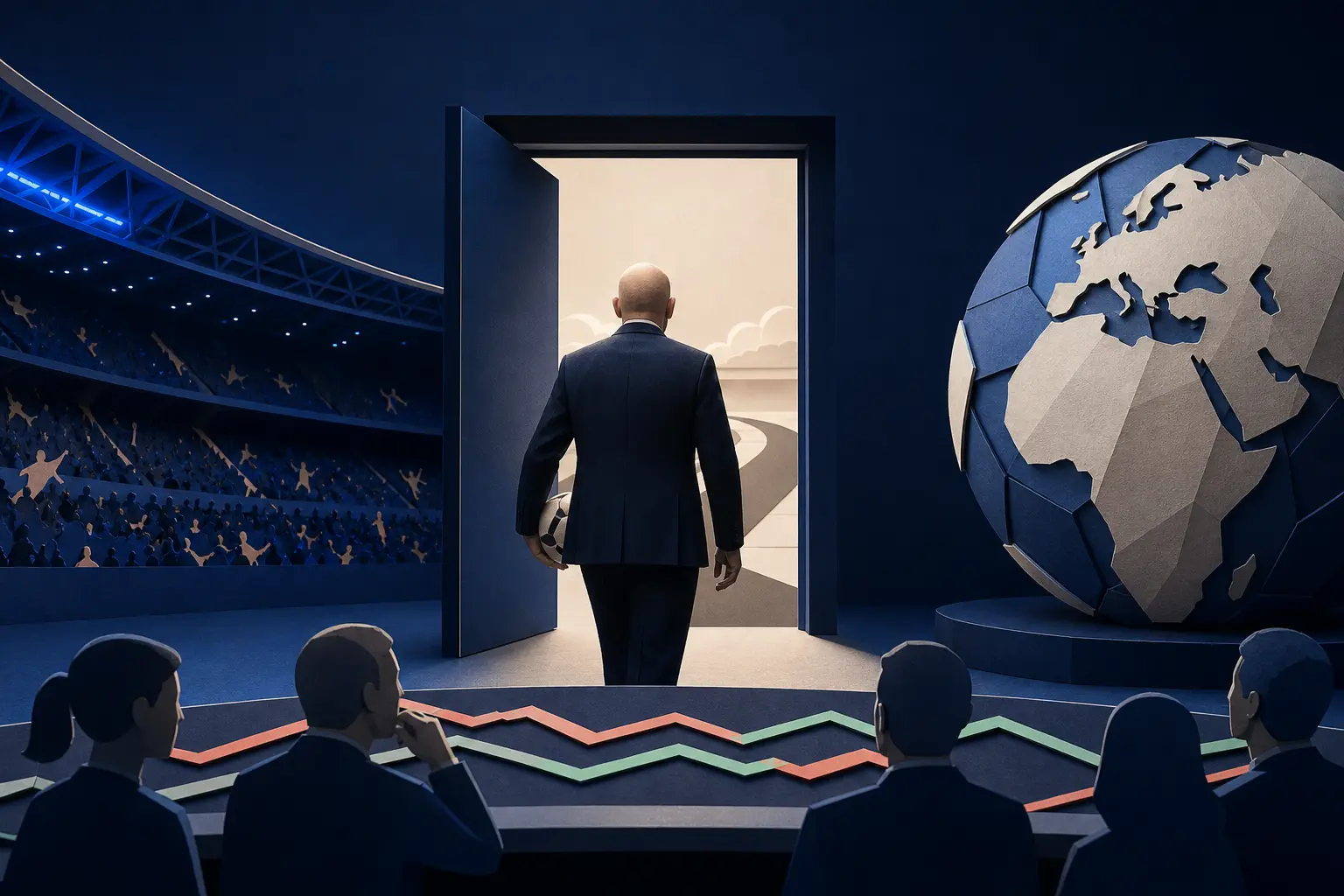
Editorial illustration for: Will Gianni Infantino leave the FIFA presidency by 31 December 2026?

How the contract works

A contract on this question settles at $1 if Infantino ceases to be FIFA president, or publicly announces resignation or an intention to resign, at any point before 31 December 2026, 11:59 PM ET. It settles at nothing if he remains president through that date, under the stated terms โ€” a temporary suspension or administrative leave does not count as leaving. The price at any moment reflects what buyers and sellers collectively think the chance is: a contract priced at 0.30, for example, would imply the market sees roughly a three-in-ten chance of Infantino leaving by year end. A position in this contract can typically be sold before the settlement date at whatever price the market has moved to by then.
What the market thinks happens
$100
Yes4%

The event happens

Costs now
$0.04
If you put in $100
$2,500
No96%

The event does not happen

Costs now
$0.96
If you put in $100
$104

Probability

History starts collecting once the event is tracked

How the price has moved

The consensus figure sits at 4%, drawn from a single actively tracked venue, Polymarket, with $578,938 traded. There is no reported sharp move associated with a specific news event; the pricing appears to reflect a steady read that the structural and calendar factors โ€” no scheduled election, the World Cup months away โ€” leave little room for an early exit. Where a market shows a low, largely settled-looking number on thin volume, that is itself informative: it signals a question most traders see as close to resolved rather than one being actively repriced around new information.

Analysis

Context

Gianni Infantino took over FIFA's presidency in February 2016, succeeding Sepp Blatter after the bribery scandal that gutted FIFA's leadership. He was re-elected in 2019 and again, unopposed, in 2023, with that term set to run until the FIFA Congress in 2027. There is no scheduled presidential vote inside the window this question covers. The backdrop to 2026 is the men's World Cup, co-hosted by the United States, Canada and Mexico, the first 48-team edition of the tournament and the biggest commercial and logistical undertaking FIFA has run. Infantino has spent years positioning this expanded format, new revenue deals, and FIFA's broader US presence as his legacy project. Walking away from FIFA in the months before or during that tournament would be an unusual move for any sitting federation president, let alone one who has built his public identity around it. Infantino has also faced periodic criticism over governance, his relationship with Gulf states and Saudi Arabia's expanding football investments, and questions about FIFA's ั„ะธะฝะฐะฝัะพะฒั‹ะต disclosures, but none of that has translated into a formal removal process or a credible internal challenger during this term.
The consensus figure across tracked venues sits at 4%, with $578,938 in total volume, almost all of it on Polymarket. That is a thin market by the standards of major political or macro contracts, but the number itself is informative: a 4% implied probability means traders overwhelmingly expect Infantino to remain FIFA president through the end of 2026, with only a small tail risk priced in for resignation, removal, or death in office. The structural case for that pricing is straightforward. FIFA's presidential term runs on a four-year cycle tied to its Congress, and the next scheduled election is in 2027, not 2026. Infantino was returned unopposed in 2023, which means there is no standing internal challenger with the votes or momentum to force an early contest. Unlike parliamentary systems with no-confidence mechanisms, FIFA's Congress has no routine procedure for removing a sitting president mid-term absent a major ethics finding or criminal process โ€” and nothing of that magnitude is currently public. The calendar argument compounds this. The 2026 World Cup across the US, Canada and Mexico is the largest and most commercially significant tournament FIFA has staged, expanded to 48 teams for the first time, and it is scheduled for June and July 2026. Infantino has spent a decade building toward this moment, from the expanded format to new sponsorship and broadcast arrangements. A resignation or removal in the months surrounding that tournament would be a significant departure from how federation leaders have historically handled their signature events; Blatter's own exit in 2015 came only after a criminal investigation and sponsor revolt, not a voluntary step-down during a tournament cycle. The thinness of the market โ€” under $600,000 in volume concentrated on one venue โ€” suggests this is a niche contract rather than one tracking a live news cycle, which is consistent with a question most participants see as close to settled rather than genuinely contested.

What moves the probability

  1. No scheduled election before 2027

    Infantino's current term, secured unopposed in 2023, runs to the next FIFA Congress in 2027. There is no routine mechanism inside this window to replace him, which is the single largest factor keeping the probability low.

  2. World Cup 2026 timing

    The expanded 48-team World Cup across the US, Canada and Mexico runs in June and July 2026, the signature event of Infantino's presidency. Leaving before or during it would be a sharp break from how federation leaders typically handle tournaments they have personally championed.

  3. Absence of a credible internal challenger

    No confederation bloc has publicly organised around an alternative candidate during this term, which removes the political pressure that preceded Blatter's 2015 exit.

  4. Governance and ethics scrutiny

    Recurring criticism over FIFA's ties to Gulf states, Saudi investment in football, and financial transparency keeps a tail risk alive, though none of it has produced a formal removal process to date.

  5. Health or unforeseen personal events

    Any sitting official's sudden departure can come from factors with no advance signal, such as illness; this is the kind of risk markets price in thinly even when there is no specific reason to expect it.

The case for

  • A major ethics or criminal finding against Infantino emerges before 31 December 2026 and forces a Congress-level response.
  • Infantino announces his own intention to step aside, for personal or political reasons, at any point before the deadline.
  • A confederation revolt, most plausibly from UEFA or a bloc of national federations, builds enough momentum to force an extraordinary Congress and a resignation.
  • An unforeseen health event removes him from office permanently rather than on temporary leave.

The case against

  • His term runs to the 2027 Congress, so there is no scheduled vote inside this window that could remove him through ordinary process.
  • The 2026 World Cup across the US, Canada and Mexico is the central project of his presidency, giving him a strong personal and institutional reason to remain through it.
  • No confederation or national federation bloc has publicly organised around a rival candidate during this term.
  • FIFA has weathered governance criticism of Infantino before without it translating into a formal removal mechanism.

What to watch

The clearest marker ahead is the World Cup itself, running June and July 2026 across the US, Canada and Mexico; Infantino's conduct before, during and immediately after that tournament is the period most likely to generate news that could move this. Any FIFA Council meeting or Congress session scheduled before the end of 2026 is worth tracking for governance disputes. Beyond that, the main triggers would be unscheduled: a formal ethics complaint, a criminal investigation opened by a national or international prosecutor, or a confederation statement calling for his removal.

Trade this contract

Venues (1)

More about this event

Venues (1)

Resolution rules

Determined by
FIFA official statements and credible sports journalism (e.g. Reuters, AP, ESPN)
Resolution date

This settles using FIFA's own official statements together with reporting from established outlets such as Reuters, AP or ESPN. It resolves Yes if Infantino ceases to be FIFA president for any length of time, or announces a resignation or an intention to resign, before 31 December 2026, 11:59 PM ET. Temporary suspensions or administrative leave are explicitly excluded and do not trigger a Yes outcome.

Calculation methodology โ†’

Local context

For English-language sports audiences, this question is tied directly to the World Cup landing in their own backyard. The United States and Canada are co-hosts in 2026, alongside Mexico, which means ticketing, broadcast rights in the US and UK, and sponsorship arrangements Infantino has personally negotiated all run through his office. A change in FIFA leadership during the tournament cycle would touch the organisational chain behind matches played in US and Canadian stadiums, making Infantino's tenure more than a distant governance story for this audience.

Common questions

What exactly settles this contract, and when?
It settles based on FIFA official statements and credible sports journalism such as Reuters, AP or ESPN, judged against 31 December 2026, 11:59 PM ET. It resolves Yes if Infantino ceases to be president for any length of time, or announces a resignation or intention to resign, before that deadline.
Does a suspension count as leaving?
No. The settlement rules explicitly exclude temporary suspensions or administrative leave. Only a genuine end to his presidency, or a public resignation announcement, counts as a Yes.
What does the current market price actually mean?
The price is the market's collective estimate of the probability, not a prediction from any single analyst. A low price means most trading activity reflects an expectation that Infantino remains president through the deadline, not that an exit is impossible.
Why is his term not up for election before 2027?
FIFA presidential terms run on a four-year cycle tied to the Congress. Infantino was re-elected unopposed in 2023 for a term extending to 2027, so there is no ordinary election scheduled inside the window this question covers.
What happens if news is ambiguous, like a reported but unconfirmed resignation?
Settlement relies on FIFA's own statements or confirmed reporting from established outlets. An unconfirmed rumour would not be sufficient; a clear announcement or confirmed departure is needed before the deadline.
Why does the World Cup matter to this question?
The 2026 World Cup across the US, Canada and Mexico is the largest event of Infantino's presidency, run in June and July 2026. It is widely seen as the clearest reason he would want to remain in office through the year, which weighs heavily against an early exit.

Related events